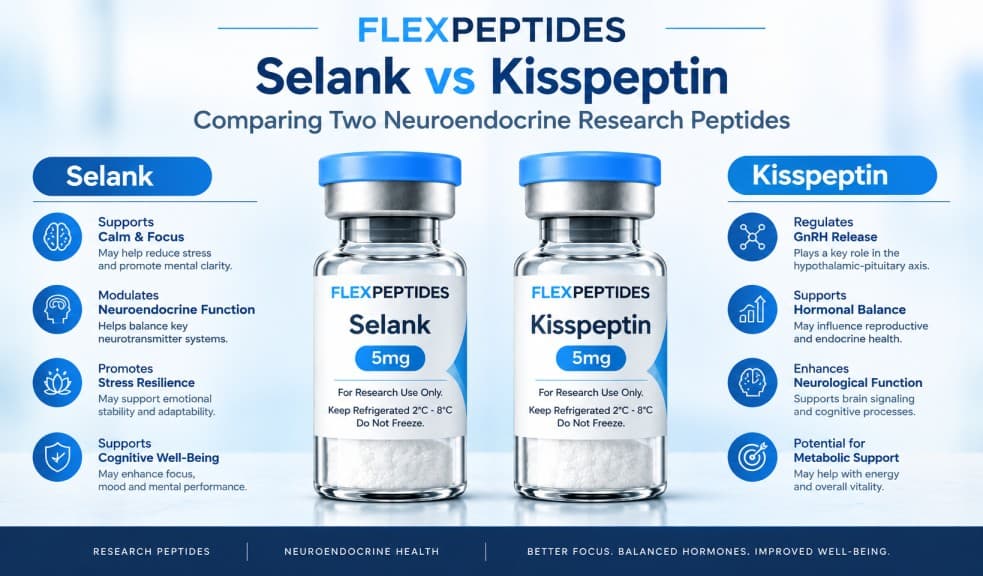
Selank and Kisspeptin are both studied for their effects on brain and hormone signalling, but they operate in entirely separate systems — Selank in anxiolytic/neurochemical research, Kisspeptin in the reproductive hormone cascade.
Different systems, occasional overlap in interest
Both peptides get filed under "neuroendocrine research" in broad category terms, which can make them seem more related than they are. In practice they're studied by different research communities, for different reasons, using different methodologies.
Selank's research profile
Selank is a synthetic analogue of tuftsin, developed in Russia and studied primarily for proposed anxiolytic (anxiety-related) effects. Its proposed mechanisms include modulation of GABA and serotonin systems, effects on BDNF (brain-derived neurotrophic factor) expression, and inhibition of enkephalinase, an enzyme that breaks down naturally occurring opioid-like peptides. Much of the foundational Selank literature originates from Russian research institutions, which is worth noting when weighing independent replication.
Kisspeptin's research profile
Kisspeptin sits at the top of the reproductive hormone cascade, triggering GnRH release from the hypothalamus. Unlike Selank, it has a genuine body of registered human clinical research behind it — including UK-based studies from groups such as Imperial College London — measuring downstream LH and FSH responses under controlled research conditions.
Comparing the evidence quality
This is the most meaningful axis of comparison: Kisspeptin's human research is more extensive and more rigorously controlled (registered clinical studies with ethical oversight) than Selank's, which remains largely preclinical and geographically concentrated. That doesn't make Selank's mechanism implausible, but it does mean the two compounds sit at different points on the evidence-maturity spectrum.
Why they might be studied in the same research programme
Some neuroendocrine research programmes examine multiple signalling systems in parallel — mood-related and reproductive-hormone pathways can interact (kisspeptin research has itself uncovered secondary effects on mood-related brain regions), which is part of why some labs maintain research interest in both compounds.
UK regulatory status
Neither compound holds a UK marketing authorisation. Both are supplied strictly for laboratory research.
Sourcing considerations
Kisspeptin's more complex synthesis makes HPLC purity verification particularly important; Selank's smaller, more established synthesis process means batch consistency is generally more predictable across suppliers. Flex Peptides lists both with COA data available on request.
Choosing Between Them for a Specific Study Design
These two compounds serve such different research purposes that the choice between them is rarely genuinely ambiguous in practice — the more useful question for a research team new to either is what evidence-maturity level they're prepared to work with. Kisspeptin's registered human clinical research base, including UK studies with rigorous ethical oversight, gives researchers working in reproductive endocrinology a comparatively mature body of directly relevant human data to draw on when designing a new study or interpreting existing findings. Selank's evidence base remains considerably earlier-stage and more geographically concentrated, which means researchers working with it are relying more heavily on mechanistic plausibility (GABA, serotonin, BDNF and enkephalinase-related pathways) than on a broad, independently replicated evidence base.
This distinction matters practically: a researcher designing a new protocol around Kisspeptin can draw on a wider base of methodologically rigorous prior work to inform dosing, timing and measurement approach. A researcher working with Selank is operating in a comparatively less mapped-out research landscape, which brings both more scientific uncertainty and, for some research questions, more genuine novelty.
It's also worth noting that the research communities working on each compound rarely overlap directly — reproductive endocrinology and neuropharmacology are distinct specialisms with different journals, conferences and methodological conventions — which is part of why a genuinely integrated study examining both signalling systems together is uncommon. When such studies do occur, they typically originate from a specific observed connection (such as kisspeptin's documented effects on mood-related brain regions) rather than from a general research programme designed from the outset to study both compounds jointly. Researchers interested in the potential overlap between reproductive and mood-related neuroendocrine signalling should treat this as an emerging, narrow research question rather than an established area of the literature. As with any cross-disciplinary research question, a study bridging the two would need investigators or collaborators familiar with both fields' methodological standards to be considered credible by either research community. Without that dual expertise, findings risk being dismissed by one field as methodologically unfamiliar or by the other as insufficiently grounded in the relevant physiology, which is a real practical barrier to this kind of cross-disciplinary work getting funded and published.
Key takeaways
- Selank is studied for proposed anxiolytic effects via GABA/serotonin/BDNF pathways; Kisspeptin triggers the reproductive hormone cascade via GnRH.
- Kisspeptin has a stronger body of registered human clinical research, including UK studies.
- Selank's foundational research is more geographically concentrated, a relevant caveat for independent replication.
- Both are sold strictly for laboratory research.
- The two are sometimes studied together in broader neuroendocrine research programmes.
FAQ
Is Selank's research as strong as Kisspeptin's?
Kisspeptin has more extensive, registered human clinical research behind it; Selank's evidence base is comparatively earlier-stage and more geographically concentrated.Do Selank and Kisspeptin interact?
They act on separate systems, though some research has explored mood-related effects of kisspeptin signalling, creating a loose point of overlap.Why is so much of the Selank literature concentrated in one country?
Selank was developed and has been predominantly studied by Russian research institutions, which is a normal feature of how some peptide research programmes develop but is worth factoring in when assessing independent replication.Does Kisspeptin's stronger evidence base make it more "proven" than Selank?
It means Kisspeptin's proposed mechanism has been tested more rigorously in registered human studies, but "proven" isn't the right frame for either compound outside the specific, narrow research contexts in which each has actually been studied.
For laboratory research use only. Not for human use outside a registered clinical research protocol.