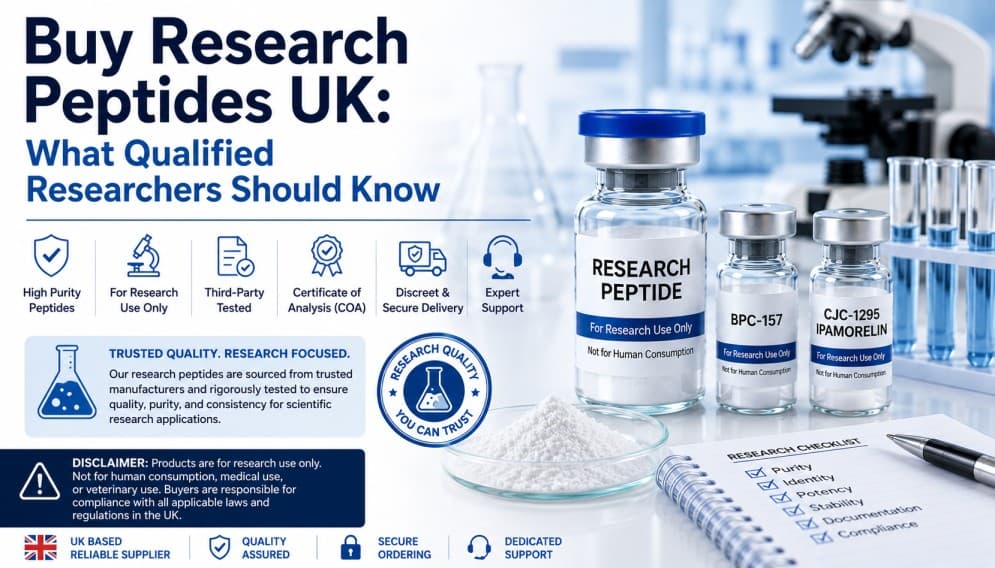
Explore recovery peptides including BPC-157, TB-500, CJC-1295 and other research compounds. Learn about peptide research in the UK.
Important Regulatory Notice
This article is intended for educational and informational purposes only.
Many peptides discussed online are classified as research compounds and are not authorised medicines approved by the UK Medicines and Healthcare products Regulatory Agency (MHRA) for treating injuries, diseases, or medical conditions.
The information provided does not represent medical advice, diagnosis, or treatment recommendations. Individuals should consult an appropriately qualified healthcare professional for any health-related decisions.
Introduction
Recovery has become one of the most discussed areas within modern fitness, sports science, longevity research, and wellness communities.
Traditionally, performance conversations focused primarily on training intensity, exercise volume, and physical adaptation. Modern research and fitness culture increasingly recognise that recovery involves multiple interconnected factors, including:
- sleep quality
- nutrition
- mobility
- training balance
- stress management
- recovery habits
- scientific research into biological pathways
Within this wider conversation, peptides have attracted increasing interest due to their role as signalling molecules within biological systems.
Recovery peptides are frequently discussed online in relation to areas such as:
- tissue support research
- cellular signalling pathways
- collagen-related research
- growth hormone pathways
- inflammation-related mechanisms
- recovery science
However, it is important to understand that scientific interest does not always equal proven clinical effectiveness.
Some peptides have been investigated in laboratory or preclinical studies, while others remain areas of ongoing scientific research. Their regulatory status, available evidence, and approved uses vary significantly.
This guide explores the science behind recovery peptides, current research discussions, and important considerations for UK audiences.
Why Recovery Research Matters
Modern athletes and active individuals place significant demands on their bodies through:
- resistance training
- endurance exercise
- competitive sport
- repetitive movement patterns
- high-volume training schedules
Recovery is a complex biological process involving multiple systems, including:
- muscle adaptation
- connective tissue response
- energy balance
- nervous system recovery
- hormonal regulation
- sleep processes
Scientific approaches to recovery increasingly focus on understanding how the body responds and adapts after physical stress.
Research areas commonly explored include:
- exercise physiology
- regenerative biology
- cellular communication
- tissue biology
- sports medicine
Peptide research has become part of this broader scientific discussion because peptides can act as biological messengers involved in various signalling pathways.
What Are Recovery Peptides?
Peptides are short chains of amino acids that can function as signalling molecules within living organisms.
Researchers study peptides because they may interact with specific biological pathways involved in processes such as:
- cellular communication
- protein activity
- receptor signalling
- biological regulation
The term "recovery peptides" is commonly used online to describe peptides that are researched in connection with recovery-related biological mechanisms.
However, recovery peptides are not one single category of approved treatments.
Different peptides have:
- different structures
- different research backgrounds
- different regulatory classifications
- different levels of scientific evidence
Some peptides have been studied extensively in laboratory environments, while others have limited available research.
How Recovery Peptides Are Studied
Scientific peptide research may involve several stages, including:
Laboratory Research
Early research often investigates:
- biological mechanisms
- cellular responses
- molecular pathways
Preclinical Studies
Researchers may examine compounds using laboratory models to understand potential biological effects.
Clinical Research
Human studies are required to determine:
- safety
- effectiveness
- appropriate medical applications
A peptide showing interesting results in early research does not automatically mean it is proven to provide benefits in humans.
This distinction is important when evaluating information online.
Peptides and the UK Regulatory Environment
In the United Kingdom, medicines and healthcare products are regulated by the Medicines and Healthcare products Regulatory Agency (MHRA).
Before a medicine can be legally marketed with therapeutic claims, it generally requires appropriate regulatory approval and evidence supporting its safety, quality, and effectiveness.
The regulatory status of individual peptides varies.
Consumers should consider:
- whether a product has authorised medical status
- whether scientific evidence supports claims being made
- whether information comes from reliable sources
- whether claims are supported by appropriate research
A responsible approach to peptide education requires separating:
- scientific investigation
- online discussion
- approved medical applications
Understanding Evidence Quality
When researching peptides online, it is useful to evaluate evidence based on:
Research Type
Higher-quality evidence generally comes from:
- peer-reviewed studies
- controlled clinical research
- systematic scientific reviews
Regulatory Recognition
Scientific interest does not necessarily mean regulatory approval.
Transparency
Reliable educational resources should clearly explain:
- what is known
- what remains uncertain
- limitations of current evidence
Understanding these differences helps readers make better-informed decisions.