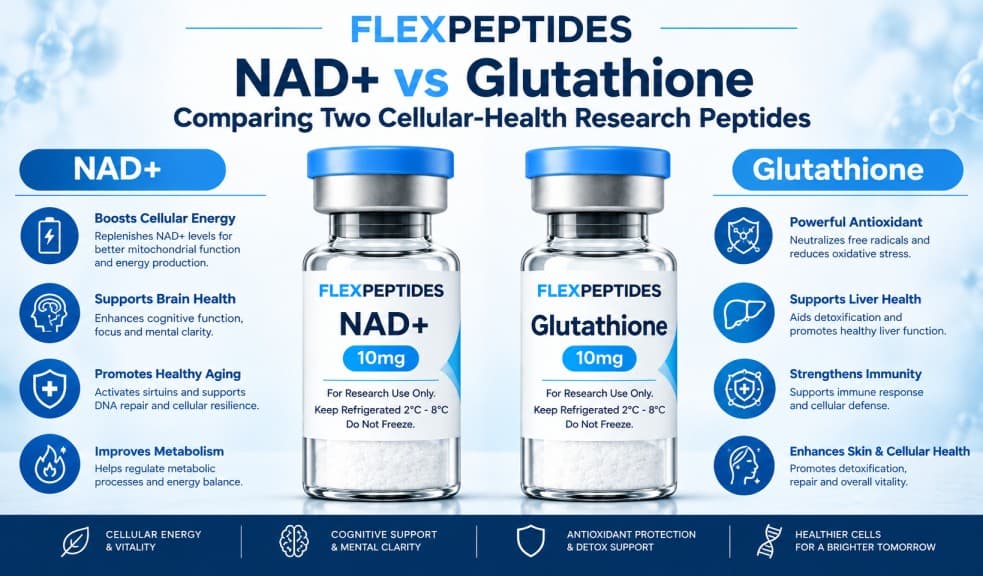
NAD+ is a coenzyme central to energy metabolism and enzyme signalling, while glutathione is a tripeptide antioxidant central to oxidative-stress defence and detoxification — related to cellular health broadly, but biochemically distinct research subjects.
Two different jobs in the cell
NAD+ and glutathione are often mentioned in the same breath in cellular-ageing and "cellular health" discussions, but they do fundamentally different jobs. NAD+ is an electron-carrying coenzyme required for energy metabolism and as a substrate for sirtuin and PARP enzymes. Glutathione is the cell's principal small-molecule antioxidant, neutralising reactive oxygen species and enabling Phase II liver detoxification.
What the NAD+ research focuses on
NAD+ research centres on its well-documented decline with age and its role as a required substrate for enzymes implicated in DNA repair and metabolic regulation — sirtuins and PARPs specifically. This has made it a focal point of ageing-biology research examining whether restoring NAD+ availability influences the downstream processes these enzymes govern.
What the Glutathione research focuses on
Glutathione research centres on oxidative stress: the GSH/GSSG ratio is a standard laboratory marker across an unusually wide range of research fields, from neuroscience to toxicology to general cell biology, because oxidative stress is a variable relevant to so much of that work.
Where the research overlaps
Both are studied in ageing-biology and general cellular-health research contexts, and some study designs examine both markers together, since oxidative stress and NAD+ depletion are thought to interact — declining NAD+ availability can affect antioxidant enzyme function, and oxidative damage can, in turn, affect NAD+-consuming repair pathways. That interaction is itself an active research question rather than a settled finding.
Practical differences for researchers
NAD+ is chemically less stable and more sensitive to freeze-thaw cycling and light exposure than glutathione, which affects storage protocols. Glutathione's main practical research variable is oxidation state — checking the reduced (GSH) percentage on a COA, rather than treating "glutathione" as a single stable species.
UK regulatory status
Neither compound holds a UK marketing authorisation for therapeutic use in research-grade form; both are supplied strictly for laboratory use.
Sourcing considerations
Storage-condition transparency from the supplier matters for both, given their respective stability profiles. Flex Peptides lists both with COA data available on request and UK-based dispatch.
Choosing Between Them for a Specific Study Design
Deciding which of these two research subjects is relevant to a given protocol usually comes down to which specific cellular process is under investigation. A study measuring energy metabolism, mitochondrial function, or sirtuin/PARP-dependent DNA repair activity has a direct reason to focus on NAD+ specifically, since these are the pathways for which NAD+ availability is a required substrate. A study measuring oxidative stress, redox balance, or Phase II detoxification capacity has more reason to centre on glutathione and the GSH/GSSG ratio, which is the standard laboratory marker for that specific biological question.
Where the two genuinely intersect is in ageing-biology research examining both pathways together, on the reasoning that declining NAD+ availability and increasing oxidative stress may interact — a hypothesis that remains under active investigation rather than settled. Researchers designing a study that touches both markers should treat that interaction as a specific research question in its own right, not assume the relationship in either direction without dedicated measurement of both variables in the same model.
Researchers should also be cautious about a common simplification in secondary literature: treating "NAD+ decline" and "increased oxidative stress" as two symptoms of a single unified ageing process, rather than as two distinct, independently measurable biochemical phenomena that happen to correlate in many study populations. Correlation between the two markers across an ageing cohort doesn't establish that one drives the other, and untangling causality — does declining NAD+ availability impair antioxidant enzyme function, does oxidative damage consume NAD+-dependent repair capacity, or do both result from a shared upstream cause — remains a genuinely open question that a well-designed study needs to address explicitly rather than assume from population-level correlation alone. A study designed to isolate causality typically needs to manipulate one variable (for example, depleting glutathione experimentally) while holding the other constant, rather than simply observing both markers change together over time in an unmanipulated population. Without that kind of controlled manipulation, any claim about which marker "drives" the other in a given research model remains an inference rather than a demonstrated finding, and should be presented to readers with that caveat attached.
Key takeaways
- NAD+ is a coenzyme for energy metabolism and enzyme signalling; glutathione is an antioxidant tripeptide.
- NAD+ research centres on age-related decline and sirtuin/PARP substrate availability.
- Glutathione research centres on oxidative stress markers across a broad range of fields.
- The two are thought to interact biochemically, though that interaction remains an active research question.
- Storage stability considerations differ meaningfully between the two compounds.
FAQ
Are NAD+ and glutathione the same type of molecule?
No — NAD+ is a dinucleotide coenzyme, glutathione is a tripeptide; they're grouped together commercially but are biochemically distinct.Do NAD+ and glutathione levels affect each other?
Some research suggests an interaction between NAD+ availability and antioxidant enzyme function, though this remains an active area of study.Which is measured more directly in a typical assay — NAD+ or glutathione?
Both have well-established, direct measurement methods (HPLC or enzymatic cycling assays for NAD+; various redox assays for the GSH/GSSG ratio), though the choice of assay depends on what the study specifically aims to characterise.Should a cellular-ageing study measure both markers together?
Many ageing-biology protocols do, given the proposed interaction between NAD+ availability and oxidative stress, though this adds complexity to study design and interpretation compared to measuring either marker alone.
For laboratory research use only. Not for human consumption.