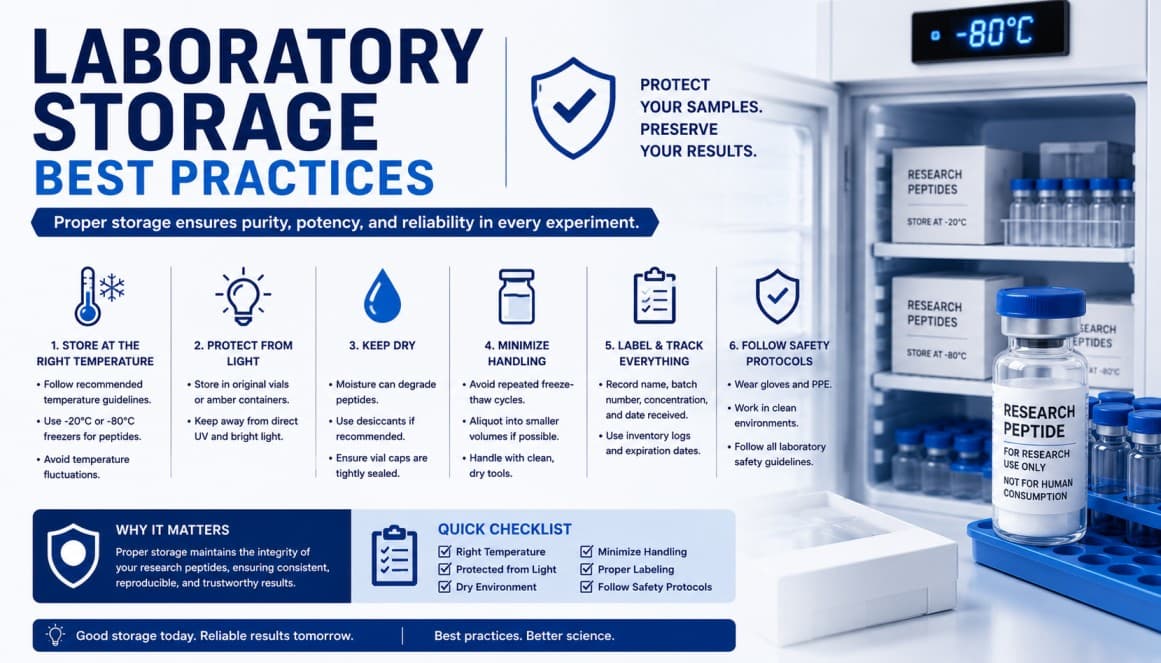
Proper peptide storage is essential for maintaining stability and integrity. Explore best practices for handling, storing, and preserving research compounds in the laboratory.
Even the highest-quality peptide can be rendered useless by poor storage. Peptides are structurally delicate molecules, and factors like temperature, light exposure, and moisture can all accelerate degradation — sometimes long before that degradation is visually apparent. This article covers the storage fundamentals every researcher should follow to protect the integrity of their material from the moment it arrives.
Why Storage Matters So Much for Peptides
Peptides are chains of amino acids held together by bonds that can be broken down through oxidation, hydrolysis, or aggregation. These processes are accelerated by heat, light, and humidity. Once a peptide has degraded, no amount of careful experimental design afterward can compensate for it — the compound itself is no longer what the label says it is.
This is precisely why storage deserves as much attention as the initial decision to buy peptides UK in the first place. A well-sourced peptide handled poorly after arrival can produce just as much unreliable data as a poorly-sourced one.
Storage Guidelines by Peptide Form
Lyophilised (freeze-dried) peptides
Most research peptides UK suppliers ship product in lyophilised form, as this significantly extends shelf life compared to reconstituted liquid. Lyophilised peptides should generally be stored at -20°C, protected from light, in a sealed, moisture-free container. Under these conditions, many peptides remain stable for extended periods, often a year or more, though this varies by compound.
Reconstituted (liquid) peptides
Once a peptide has been reconstituted with a diluent, its stability window shortens considerably. Reconstituted peptides are typically far more sensitive to temperature fluctuations and should be stored refrigerated (around 2–8°C), used within the supplier's recommended timeframe, and never left at room temperature for extended periods.
Key Environmental Factors to Control
Temperature
Consistent cold storage is the single most important factor in peptide stability. Repeated freeze-thaw cycles, in particular, can degrade peptide structure — so avoid unnecessary removal from the freezer, and consider aliquoting larger quantities into smaller portions to minimise repeated exposure.
Light exposure
Many peptides are photosensitive, meaning UV and even standard laboratory lighting can contribute to degradation over time. Amber vials, foil wrapping, or simply storing containers inside a closed, opaque box within the freezer or fridge can help mitigate this.
Moisture and humidity
Lyophilised peptides are hygroscopic, meaning they readily absorb moisture from the air. Once exposed, this can affect both stability and solubility. Vials should be kept sealed until ready for use, and where possible, stored with desiccant packs.
Handling and contamination
Basic sterile technique matters when reconstituting or aliquoting peptides — using appropriate laboratory gloves, clean equipment, and minimising exposure to open air reduces the risk of microbial contamination affecting a sample.
Building a Reliable Storage Protocol
For labs working with multiple research grade peptides across different studies, a documented storage protocol helps maintain consistency:
- Label every vial clearly with peptide name, batch number, and date received.
- Log storage location and conditions for each batch, so any deviations can be traced.
- Track freeze-thaw cycles for lyophilised material and reconstitution dates for liquid samples.
- Periodically review supplier-recommended shelf life against your own usage timeline to avoid working with material past its stable window.
Suppliers of laboratory peptides UK should provide clear storage instructions specific to each product, and a reputable UK peptide supplier will typically include this information directly on the product page or accompanying documentation. Flex Peptides (flexpeptides.co.uk) is one example of a supplier presenting storage guidance alongside its product catalogue, which researchers should reference directly when planning their own laboratory protocols.
Common Storage Mistakes to Avoid
- Leaving reconstituted peptides at room temperature for convenience during a busy experiment day
- Repeatedly freezing and thawing the same vial rather than aliquoting into single-use portions
- Storing vials in a freezer door, where temperature fluctuates more than in the interior
- Failing to track how long a reconstituted sample has been in use relative to its recommended stability window
Final Thoughts
Storage is one of the most controllable variables in peptide research, yet it's often the one most easily overlooked once a shipment arrives. Establishing clear, documented storage practices — and following supplier-specific guidance closely — helps ensure that the integrity established during sourcing and testing isn't undone during the storage phase.
Disclaimer
This article is provided for general informational and educational purposes only. All peptides referenced here, including those sold by Flex Peptides (flexpeptides.co.uk), are not approved by the MHRA, FDA, or any other regulatory body for human or veterinary use, diagnosis, treatment, cure, or prevention of any disease or condition. Products are intended strictly for laboratory and in-vitro research purposes by qualified professionals and are explicitly not for human or animal consumption. Nothing in this article constitutes medical advice. Always consult a licensed physician or qualified healthcare professional regarding any health-related questions, and consult appropriate regulatory guidance before purchasing, handling, or storing any research chemical. The author and publisher accept no liability for misuse of the information contained in this article.