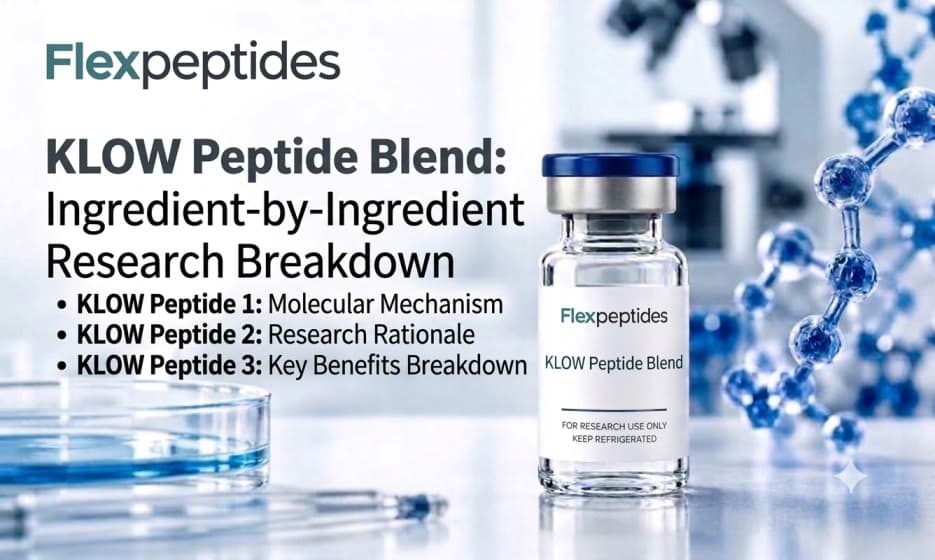
KLOW is a commonly referenced peptide blend combining several compounds studied for skin, tissue-repair and anti-inflammatory research — this breakdown looks at each typical component's individual research profile, distinct from any claim about the combined blend's own effects.
Why we're breaking this down component by component
As covered in our blend-formulation article, a blend's marketing shouldn't imply that each component's individual research automatically applies to the combined product. This breakdown treats each typically included compound's research separately and honestly, exactly for that reason.
Component research profiles (check against your specific supplier's disclosed formulation)
GHK-Cu contributes its well-documented gene-expression research profile relevant to collagen synthesis and tissue remodelling — see our dedicated GHK-Cu deep-dive for the detail.
KPV contributes its research profile as the smallest active fragment of alpha-MSH, studied for isolated anti-inflammatory signalling separate from pigmentation effects.
Other components commonly referenced in blends marketed under this name may include additional tissue-repair or hormone-related peptides — always verify a specific supplier's exact disclosed composition rather than assuming based on the product name alone, since formulations vary between manufacturers.
Why disclosure verification matters here specifically
Because "KLOW" isn't a single standardised formula across every manufacturer using the name, checking a specific supplier's exact ingredient list and ratios — rather than assuming based on what's commonly described online — is a meaningful quality and transparency check in its own right.
What this breakdown doesn't claim
This article describes typical component research individually; it does not claim that the combined blend has been studied as a single formula with the same rigour as its individual components, a distinction covered in more depth in our blend-formulation article.
Sourcing KLOW with disclosed composition
Flex Peptides discloses its KLOW blend's exact composition, alongside Certificate of Analysis data available on request.
Why understanding individual components still helps interpret a blend
Even though this article is explicit that combined-blend evidence is distinct from individual-component evidence, understanding each component's individual research profile is still genuinely useful groundwork for thinking about a blend's proposed rationale. Knowing that GHK-Cu's research base centres on gene-expression pathways relevant to tissue remodelling, and that KPV's centres on isolated anti-inflammatory signalling, allows a researcher to at least understand the mechanistic reasoning a manufacturer likely had in mind when combining them — a useful starting point for forming hypotheses about the blend, even while recognising that this reasoning hasn't been directly confirmed through dedicated combined-formula study.
Cross-referencing a blend's disclosed formulation against primary literature
For a researcher who wants to go a level deeper than this general breakdown, cross-referencing a specific supplier's exact disclosed formulation against the primary published literature for each named component individually is a worthwhile exercise. This allows a more informed, first-hand judgment of how plausible the manufacturer's implied combined rationale actually is, rather than relying solely on secondary summaries — and it's a natural extension of the same COA-literacy and source-verification habits discussed elsewhere in this guide, applied specifically to formulation rationale rather than purity data.
A closer look at how each component's research context differs
GHK-Cu's individual research base spans a considerable range of gene-expression and tissue-remodelling literature, giving it one of the more substantial individual evidence bases among peptides commonly included in blends of this kind — see the dedicated GHK-Cu article for the full picture. KPV's individual research, by contrast, centres more specifically on its isolated anti-inflammatory signalling properties as a fragment of a larger parent molecule, a narrower but still genuine area of study in its own right. Recognising that these two components bring meaningfully different depths and types of individual research to a blend is a more accurate way to think about a formulation's overall evidence base than treating "the blend has research behind it" as a single undifferentiated claim.
Verifying a blend's disclosed ratios where possible
Beyond simply confirming which components are present, some suppliers go a step further and disclose approximate ratios or relative proportions for a blend's components, which supports a somewhat more informed evaluation than an ingredient list alone. Where this level of disclosure isn't offered, it's reasonable to ask a supplier directly whether more specific ratio information is available, even if it isn't published by default — a request that, per the general standard recommended throughout this guide, a transparent supplier should be able to engage with constructively rather than deflecting or declining to discuss it at all. This same standard of directness applies equally to questions about why particular components were chosen in the first place, not just to questions about the ratios between them, and a supplier's response to both kinds of question, taken together, is genuinely worth weighing when forming an overall impression of that supplier.
Key takeaways
- KLOW commonly combines peptides like GHK-Cu and KPV, among possible other components depending on the manufacturer.
- Each component's individual research profile is distinct from any claim about the combined blend's effects.
- "KLOW" isn't a single standardised formula — always verify a specific supplier's exact disclosed composition.
Ingredient disclosure and verification matter especially for blend products. - Cross-referencing a disclosed formulation against each component's own primary literature is a worthwhile extra step for a thorough evaluation.
- This breakdown describes typical components' individual research, not combined-blend-specific evidence.
FAQ
Is KLOW the same formula from every supplier?
Not necessarily — always check a specific supplier's disclosed exact composition rather than assuming a standardised formula.
Has KLOW itself, as a combined blend, been studied directly?
Dedicated combined-blend research is generally more limited than research on its individual components studied separately.
For laboratory research use only. Not for human or veterinary use.