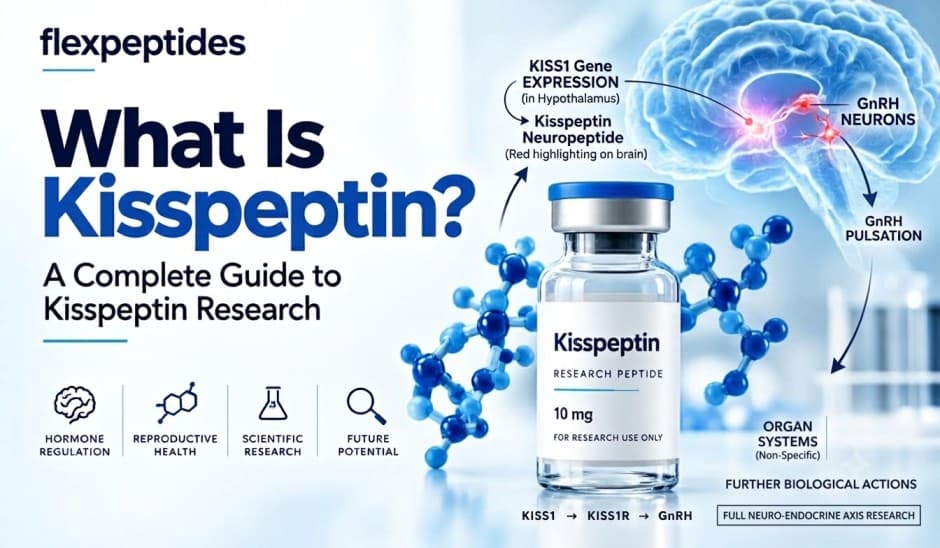
Kisspeptin sits at the top of the reproductive hormone cascade, triggering GnRH release from the hypothalamus. This article goes beyond the basic overview to look specifically at what human research studies — a rarity in this field — have actually measured.
A recap: why Kisspeptin is unusual in this field
Kisspeptin's research history is unusual among the peptides in this catalogue for one specific reason: it was originally identified as a metastasis-suppressor gene product (hence "KISS1", named for Hershey's Kisses, made in Hershey, Pennsylvania, where it was discovered) before researchers found its unrelated and far more significant role as the primary trigger for GnRH (gonadotropin-releasing hormone) release from the hypothalamus — the signal that sits at the very top of the reproductive hormone cascade in both sexes.
What makes the human research different
Unlike most peptides in this catalogue, kisspeptin has a genuine body of registered human research behind it, most notably from groups including Imperial College London, who have run controlled studies administering kisspeptin to human volunteers and measuring downstream hormone responses (LH, FSH) under closely monitored clinical research conditions — this is a materially different evidence base from the animal-model-heavy literature typical of most compounds on this list.
What the published human research has measured
Registered human studies of kisspeptin administration have examined:
- LH and FSH pulsatility following controlled kisspeptin administration, measuring how reliably it triggers downstream gonadotropin release compared to baseline.
- Reproductive hormone axis studies in specific patient populations being studied for hypothalamic signalling disorders, conducted under clinical research protocols with full regulatory oversight.
- Neuroimaging studies examining kisspeptin's effects on brain regions associated with mood and sexual arousal, a secondary research interest that emerged from observations during the reproductive-hormone studies above.
It's important to be precise about what this means for UK availability: these are clinical research studies, conducted under full regulatory and ethical oversight, using controlled dosing protocols and monitored administration by clinical researchers. They are not evidence that kisspeptin sold as a research chemical is intended or appropriate for any form of self-directed use — the research-grade compound sold for laboratory use is for in vitro and preclinical laboratory research, not human administration outside a registered clinical trial.
Research status and open questions
The existence of controlled human data doesn't mean the science is settled — researchers are still working through dose-response relationships, the interaction between kisspeptin signalling and other reproductive axis regulators, and how findings from the specific patient populations studied generalise more broadly. This remains genuinely active research, published in specialist reproductive endocrinology journals.
UK regulatory status
Research-grade kisspeptin carries no UK marketing authorisation and is not an approved medicine. The clinical research described above was conducted under specific research ethics and regulatory approvals that do not extend to the research-grade compound sold commercially for laboratory use.
Sourcing research-grade Kisspeptin in the UK
Kisspeptin's more complex synthesis (it's a larger peptide than many others in this catalogue) means batch purity variation is a bigger practical concern — checking HPLC data on the COA is particularly worthwhile. Flex Peptides lists Kisspeptin with COA data available on request and UK-based dispatch.
Study Design Considerations for Kisspeptin Research
Because kisspeptin has a genuine registered human research base, researchers reviewing this literature need to be careful about the distinction between the clinical study protocols used (with specific dosing, monitoring and ethical approval processes) and any application to laboratory research using the research-grade compound, which are governed by entirely different frameworks and shouldn't be conflated. Within the human research itself, study design has varied considerably — some studies use bolus administration and measure an acute LH/FSH pulse, while others use continuous infusion protocols to study sustained receptor engagement, and these produce different results that aren't directly comparable without accounting for the administration method.
For researchers working with kisspeptin analogues or fragments in preclinical models, it's also worth noting that kisspeptin signalling interacts with several other reproductive-axis regulators (including neurokinin B and dynorphin, as part of the so-called "KNDy neuron" system), so isolating kisspeptin's specific contribution in a complex in vivo model requires careful experimental controls that account for this broader signalling network.
Key takeaways
- Kisspeptin triggers GnRH release, sitting at the top of the reproductive hormone cascade.
- It has an unusually strong body of registered human clinical research behind it, including UK-based studies.
- That research was conducted under full clinical and ethical oversight — a different context from research-grade material sold for laboratory use.
- No UK marketing authorisation exists for kisspeptin as a medicine.
- HPLC purity verification is particularly important given kisspeptin's more complex synthesis.
FAQ
Has kisspeptin been tested in human clinical studies?
Yes — kisspeptin has a genuine body of registered clinical research, including UK-based studies, which is unusual among research peptides.Does that mean kisspeptin is approved as a medicine in the UK?
No — it remains an unlicensed compound with no UK marketing authorisation; the clinical studies referenced were conducted under specific research protocols, not as part of a drug approval pathway.What is the "KNDy neuron" system mentioned in kisspeptin research?
It refers to a population of hypothalamic neurons co-expressing kisspeptin, neurokinin B and dynorphin, which together regulate GnRH pulsatility — a system researchers need to account for when isolating kisspeptin's specific effects in a study.Does bolus versus continuous kisspeptin administration produce different research findings?
Yes — the two administration methods engage the GnRH pulse-generating system differently, and published studies using one method shouldn't be assumed to produce comparable results to studies using the other without accounting for that difference.
For laboratory research use only. Not for human use outside a registered, ethically approved clinical research protocol.