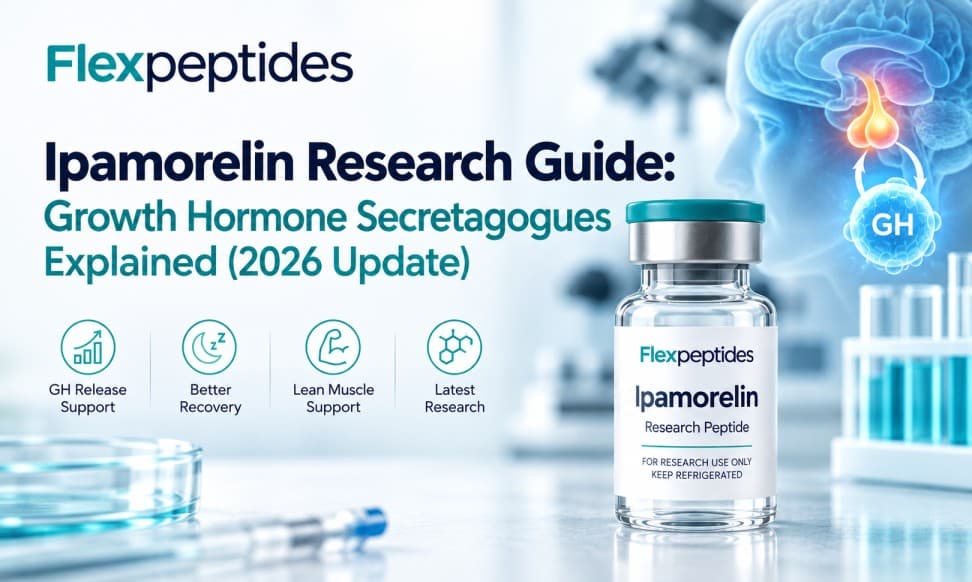
Ipamorelin is a selective growth-hormone secretagogue, studied for its ability to stimulate growth hormone release via the ghrelin (GHS-R) receptor pathway with comparatively low activity at other hormone receptors. It is sold for laboratory research use only.
What is Ipamorelin?
Ipamorelin is a pentapeptide belonging to the growth-hormone secretagogue (GHS) class, developed in the 1990s as researchers looked for compounds that could stimulate growth hormone release more selectively than earlier secretagogues, which often triggered unwanted increases in cortisol and prolactin alongside the intended effect. Ipamorelin's research profile is defined largely by that selectivity.
The proposed mechanism
Ipamorelin binds to the ghrelin receptor (GHS-R1a), the same receptor pathway activated by the natural hunger hormone ghrelin, and in research models this stimulates pituitary growth-hormone release. What distinguishes it in the receptor-pharmacology literature is a comparatively narrow binding profile — laboratory studies have found it produces less cortisol and prolactin elevation than earlier secretagogues like GHRP-6, which is why it's often described as more "selective" in the research literature.
What the published research shows
The Ipamorelin literature includes:
- Receptor-binding studies establishing its affinity for GHS-R1a relative to other secretagogues.
- Comparative endocrinology research, contrasting hormone-release profiles (growth hormone, cortisol, prolactin) between Ipamorelin and earlier-generation secretagogues in animal and in vitro models.
- Gastrointestinal motility research, since the ghrelin receptor pathway is also involved in gut motility — a secondary research interest for this receptor class distinct from its growth-hormone effects.
- Bone and body-composition studies in animal models, examining downstream effects of sustained growth-hormone axis stimulation.
Research status and open questions
Ipamorelin's selectivity profile is one of its most consistently replicated findings, which is part of why it remains a frequently referenced comparator compound in newer GHS research. What's less settled is how its effects compare quantitatively across different animal models and experimental designs — a common limitation across the secretagogue literature generally, given how much study protocols vary.
UK regulatory status
Ipamorelin carries no UK marketing authorisation and is not an approved medicine. It is supplied strictly as a research chemical for laboratory use, and reputable UK suppliers will not market it with any suggestion of a human health or performance benefit.
Sourcing research-grade Ipamorelin in the UK
As one of the more established and widely stocked secretagogues, Ipamorelin has a reasonably mature UK supplier market — which makes COA availability and batch-testing transparency a useful way to differentiate suppliers rather than relying on price alone. Flex Peptides lists Ipamorelin with COA data available on request and UK-based dispatch.
Study Design Considerations for Ipamorelin Research
Comparative secretagogue research — studies contrasting Ipamorelin with GHRP-6, GHRP-2, or GHRH analogues like tesamorelin — depends heavily on matched dosing and sampling protocols to produce meaningful comparisons, and reviewers of this literature note that inconsistent dosing schedules between studies is one of the more common limitations when trying to rank secretagogues by selectivity or potency. Because Ipamorelin's key differentiator is its comparatively low cortisol and prolactin elevation, researchers designing comparative studies typically need to measure all three hormone axes (GH, cortisol, prolactin) simultaneously rather than GH alone, since a study measuring only GH response cannot actually demonstrate the selectivity claim that defines this compound in the literature.
The ghrelin receptor's secondary role in gastrointestinal motility is also a source of potential confounding in metabolic studies — researchers studying Ipamorelin's growth-hormone effects in animal models should be aware that GI motility changes could independently affect body-weight and feeding-behaviour measurements taken during the same study, and well-designed protocols typically control for this explicitly.
Key takeaways
- Ipamorelin is a selective growth-hormone secretagogue acting via the ghrelin (GHS-R1a) receptor.
- Its defining research characteristic is comparatively low cortisol and prolactin elevation relative to earlier secretagogues.
- Published research spans receptor pharmacology, comparative endocrinology and gut-motility studies.
- No UK marketing authorisation exists for the research-grade compound.
- A mature UK supplier market makes COA transparency a meaningful differentiator when comparing options.
- Simultaneous measurement of GH, cortisol and prolactin is necessary to actually substantiate any selectivity claim made in a published research study of this specific, careful kind of experimental design.
FAQ
What makes Ipamorelin "selective"?
It binds the ghrelin receptor with comparatively little activity at receptors linked to cortisol and prolactin release, a profile established in comparative receptor-binding studies.Is Ipamorelin the same as GHRP-6 or GHRP-2?
No — they're related secretagogues acting on the same general receptor pathway but with different binding profiles and hormone-release characteristics.Why does cortisol and prolactin measurement matter in Ipamorelin studies? Because Ipamorelin's defining research characteristic is low activity at pathways linked to cortisol and prolactin release, a study can only support a "selectivity" claim if it measures all three hormones, not growth hormone alone.
Could Ipamorelin's effect on gut motility confound metabolic research findings? Potentially — since the ghrelin receptor pathway independently affects gastrointestinal motility, researchers studying body-composition or feeding-behaviour outcomes need to account for this as a possible confounding variable.
Is Ipamorelin research typically conducted in vivo or in vitro?
Both approaches appear in the literature — receptor-binding affinity is usually characterised in vitro, while hormone-release and downstream metabolic effects are studied in animal models.How does Ipamorelin's selectivity profile affect long-term study design?
Because it produces less cortisol and prolactin disruption than earlier secretagogues, researchers running longer observation periods in animal models can more confidently attribute downstream metabolic changes to sustained GH-axis activity rather than to confounding stress-hormone elevation — one reason it's often preferred as a research tool for extended protocols.
For laboratory research use only. Not for human or veterinary use.