Understanding product specifications helps researchers evaluate peptide quality with confidence. Learn how to interpret purity, peptide content, batch information, storage guidance, and Certificates of Analysis (COAs) before purchasing research products.
For research use only. Not for human consumption.
Introduction
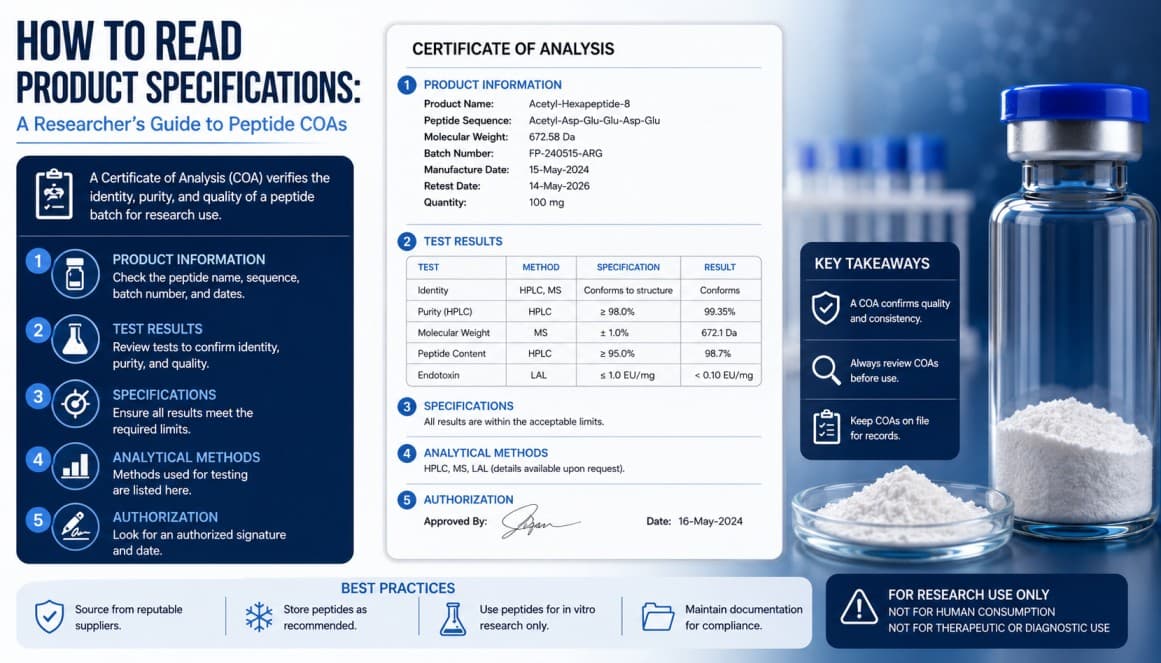
Every research peptide vial is only as useful as the documentation behind it. A Certificate of Analysis (COA) is what connects a labeled vial to a scientifically verified chemical identity — it transforms an unlabeled white powder into a scientifically verifiable reagent. This guide walks through each section of a typical peptide product specification and COA, explains what the numbers actually mean, and highlights the warning signs of an incomplete or unreliable document. Whether you're reviewing a spec sheet before ordering or checking a COA against material that just arrived, knowing how to read these documents is a core bench skill.
Why the COA Matters
For research-use-only (RUO) peptides — materials that are not approved for human or veterinary use — the COA is the primary quality-assurance tool, and because these compounds aren't regulated in the way pharmaceuticals are, the burden of verification sits largely with the researcher.A legitimate COA needs to answer, at minimum, whether the material is the correct sequence (confirmed by mass spectrometry) and how pure it is (confirmed by HPLC).
Identity: Mass Spectrometry
Purity and identity are two different questions, and a specification sheet needs to answer both. Confirming identity is typically done through liquid chromatography–mass spectrometry (LC-MS), which measures the molecular mass of the compound and matches it against the known mass of the target peptide. A COA that lists only purity without identity confirmation is incomplete — purity alone tells you that 99% of the sample is one compound, but not that the compound is the correct one. Both metrics are necessary.
When reviewing the mass spec section of a specification:
- Check that the result shows both the observed and theoretical molecular weight side by side. A COA listing only the theoretical molecular weight hasn't shown you any actual measured data.
- Look for MS/MS sequence confirmation as a bonus indicator of a more rigorous analysis, particularly for sensitive or high-stakes research applications.
- Be cautious of a mass-spec result reported with unrealistically tight tolerance — a result reported at only ±0.1% tolerance can be a red flag, since accuracy on modern LC-MS/MS instruments should typically be reported within a few parts per million.
Purity: Reading the HPLC Result
Peptide purity is verified primarily through reverse-phase HPLC, which separates the target compound from impurities and quantifies their relative peak areas. The output is a chromatogram: a plot of UV absorbance against time, where each peak represents a compound eluting from the column. The main, dominant peak represents the target peptide, while smaller peaks before or after it represent impurities.
The purity percentage itself is a calculation, not a direct measurement: purity is reported as the percentage of total peak area accounted for by the main peak — (main peak area ÷ total area of all peaks) × 100. It's worth being precise about what this number does and doesn't mean. "Purity by HPLC = 99%" almost always means that 99% of the total integrated UV peak area at the stated wavelength is accounted for by the main peptide peak — this is not the same thing as the absolute mass fraction of peptide in the powder, which is a distinct measurement (see "Net Peptide Content," below).
What to look for in the HPLC section:
- The COA should specify the HPLC method parameters — column type, mobile phase composition, flow rate, and detection wavelength. UV detection at 214–220 nanometers is standard for peptide analysis.
- Look for the actual chromatogram image itself. A stated purity percentage without the underlying chromatogram is an assertion, not evidence — a genuine COA includes the chromatogram.
- A clean chromatogram shows a single dominant peak with minimal baseline noise and few secondary peaks.
Purity benchmarks commonly referenced in the field:
Be cautious of any supplier advertising "100% purity" — this is rarely achievable in practice and often signals either misleading marketing or simple rounding. A result in the 99.5%–99.8% range represents a realistic ceiling for well-synthesized research peptides. A purity of 99% or higher is generally treated as the standard for the most rigorous research applications; results between 95–98% may be acceptable for exploratory screening work but are considered inadequate for quantitative dose-response studies or publication-grade research, and results below 95% are generally not considered suitable for reproducible research.
Net Peptide Content and Actual Mass
A vial's labeled weight and its actual measured peptide content are not always identical, and a good specification sheet will disclose both. For example, a vial labeled "30mg" may have an actual tested mass of 36.96mg according to its COA — this is normal and reflects synthesis and lyophilization variability. Reputable suppliers disclose the actual tested mass transparently rather than only stating the label amount. If a COA does not list net peptide content, there is no way to know how much of the compound is actually present in the vial — a significant problem for any research requiring quantitative accuracy.
Batch and Lot Documentation
A specification sheet is only meaningful if it is tied to the specific material being sold. A generic COA reused across multiple batches, showing the same numbers every time, is, by definition, not a genuine certificate of analysis. Because research reproducibility depends directly on compound quality consistency across batches, two researchers using peptides labeled identically but drawn from different batches — even if both are nominally "99% pure" — may see meaningfully different results if the underlying batch data differs. Look for a specific lot or batch number, paired with an analysis date and an identifiable testing laboratory.
Third-Party Verification
Credible suppliers use independent, third-party laboratories to generate COAs, rather than relying solely on in-house or self-attested testing. A COA without third-party attribution — manufacturer self-attestation with no external lab cross-check and no reference to a recognized method-validation standard — is a common failure mode worth watching for. When possible, verify that the named laboratory actually exists and, if there's any doubt, contact it directly to confirm the report.
Additional Fields to Check for Sensitive Research
Beyond the core identity and purity data, more rigorous research applications benefit from additional documentation: water content (relevant for accurate quantitative work), residual solvent data, and endotoxin testing results are all worth checking for, particularly for cell-culture or animal-model research where contamination or solvent carryover could confound results.
Common Red Flags Summary
Pulling the points above together, a specification sheet or COA should raise concern if it:
- States a purity number without naming the chromatographic method, column, or detection wavelength.
- Claims identity based on HPLC retention time alone, without mass spectrometry — a co-eluting deletion sequence can look identical to the target peptide on HPLC alone, which is why retention time cannot confirm identity by itself.
- Shows no chromatogram image, only a stated percentage.
- Lists only a theoretical molecular weight rather than an observed one.
- Is not tied to a specific lot or batch, or appears to be reused across multiple product listings.
- Provides no identifiable third-party testing laboratory.
Summary
A complete peptide specification sheet answers two separate questions — is this the right compound, and how pure is it — and answers both with actual data rather than assertions. That means an observed molecular weight alongside the theoretical one, a full HPLC method with a visible chromatogram, a specific batch number and analysis date, and ideally a named third-party laboratory behind the numbers. Learning to read these documents critically is one of the most practical skills a peptide researcher can develop, since the value of any experimental result is only as strong as the verified identity and purity of the material behind it.
A Note on Responsible Research Use
All products referenced on this site are supplied strictly for laboratory and in-vitro research use by qualified professionals and institutions, and are not intended for human or animal administration outside of a controlled research setting. Researchers should review the specific COA provided with any batch they receive and consult their institution's quality-assurance protocols.
Disclaimer: This article summarizes publicly available guidance for general scientific and educational purposes. It is not medical advice, and FlexPeptides does not sell products intended for human consumption.