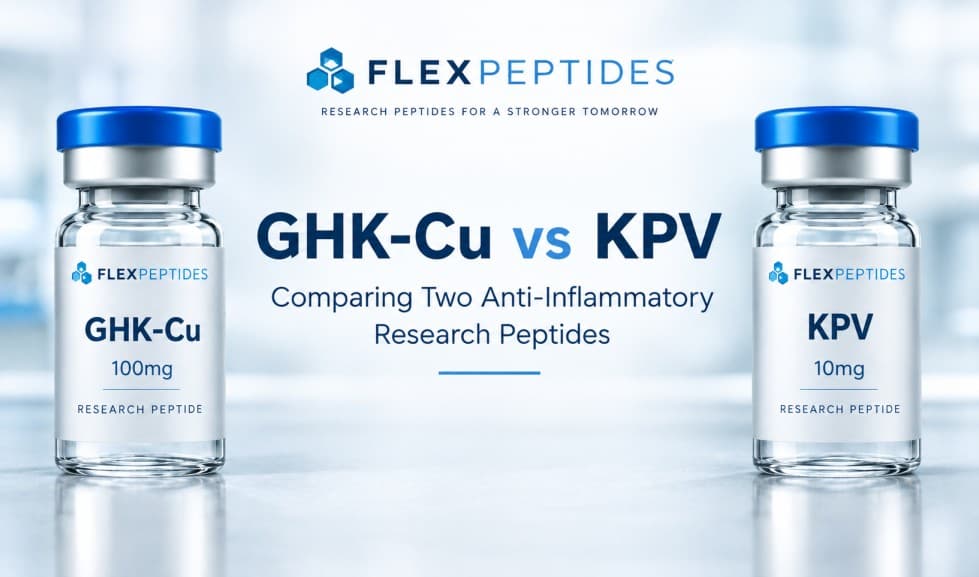
GHK-Cu and KPV are both studied in tissue-repair and anti-inflammatory contexts, but GHK-Cu is a copper-binding gene-expression modulator while KPV is the smallest active fragment of alpha-MSH, isolating its anti-inflammatory signal.
Two different anti-inflammatory stories
Both peptides show up in inflammation-related research, but the underlying science is quite different. GHK-Cu's research profile is built on gene-expression effects relevant to tissue remodelling; KPV's is built on isolating one specific signal from a larger, better-known hormone.
What GHK-Cu's research covers
GHK-Cu is a naturally occurring copper-binding tripeptide studied for its effects on collagen synthesis, tissue remodelling gene expression, and antioxidant/copper-chelating activity — a broad, multi-pathway profile established largely through DNA microarray and fibroblast culture studies.
What KPV's research covers
KPV is just three amino acids — the smallest active fragment of alpha-melanocyte-stimulating hormone (alpha-MSH) — and its research interest is specifically about isolating alpha-MSH's anti-inflammatory signalling from its separate, better-known pigmentation effect. Most of the published KPV research concerns gut-inflammation models, examining its effects independent of the pigmentation pathway that limits alpha-MSH's usefulness as a research tool for inflammation specifically.
Comparing mechanisms
GHK-Cu works through broad gene-expression modulation across many pathways simultaneously. KPV's appeal to researchers is almost the opposite: it's valued for its narrowness — a clean, isolated anti-inflammatory signal without the confounding pigmentation effects of the parent hormone. That difference in scope (broad multi-pathway vs. narrow isolated signal) is the most useful way to think about how these two compounds are actually used in a research design.
Comparing the evidence bases
GHK-Cu has a larger, longer-running body of published research, partly due to commercial cosmetic-science interest. KPV's literature is smaller and more concentrated in gut-inflammation models specifically, reflecting its more recent emergence as a distinct research subject separate from alpha-MSH generally.
UK regulatory status
Neither compound holds UK marketing authorisation. Both are supplied strictly for laboratory research use.
Sourcing considerations
GHK-Cu's copper ratio and KPV's small-peptide purity are both worth checking specifically on a COA rather than relying on a general purity percentage. Flex Peptides lists both with COA data available on request.
Choosing Between Them for a Specific Study Design
The practical choice between GHK-Cu and KPV in an anti-inflammatory or tissue-repair research context depends heavily on how broad or narrow a mechanistic question the study is designed to answer. Researchers interested in a multi-pathway gene-expression effect — where collagen synthesis, matrix remodelling and antioxidant activity might all be relevant simultaneously — have more reason to work with GHK-Cu, given its established, if broad, mechanistic profile. Researchers who specifically want to isolate an anti-inflammatory signal without the confounding pigmentation effects that come with alpha-MSH itself have a clear, well-defined reason to reach for KPV instead, precisely because narrowness is the point of that compound's research design.
It's also worth noting that these two compounds have quite different literatures in terms of research-group diversity: GHK-Cu's larger body of work, partly driven by commercial cosmetic-science interest, spans a wider range of independent labs, while KPV's smaller, more recent literature is more concentrated in gut-inflammation-specific research groups. Neither pattern is unusual for peptides at these different stages of research maturity, but it's a relevant factor when assessing how much weight to give published findings for either.
Researchers should also weigh how each compound's mechanism has been validated methodologically: GHK-Cu's gene-expression effects have been characterised using increasingly standardised microarray and RNA-seq platforms across multiple independent labs, giving a reasonably consistent picture of which gene sets respond to exposure. KPV's anti-inflammatory signalling, by contrast, has been characterised using a narrower range of assay types, largely within gut-inflammation models specifically, which means its evidence base — while mechanistically clean — hasn't yet been tested across as wide a range of experimental contexts as GHK-Cu's has. This doesn't diminish KPV's research value, but it does mean generalising its anti-inflammatory findings beyond the gut-inflammation contexts where it's been studied should be done cautiously. Researchers extending KPV research into new tissue types or inflammatory models should treat that extension as a genuinely new research question requiring its own dedicated validation work, not an assumed continuation of the existing gut-inflammation findings. This is a general principle across peptide research worth restating: a mechanism demonstrated in one tissue or model system is a hypothesis for a different system, not a finding that automatically transfers.
Key takeaways
- GHK-Cu acts through broad gene-expression modulation; KPV isolates a single anti-inflammatory signal from alpha-MSH.
- GHK-Cu's evidence base is larger and includes cosmetic-science-funded research; KPV's is smaller and gut-inflammation-focused.
- The "broad vs narrow" mechanism distinction is the most useful comparison point between the two.
- Neither holds UK marketing authorisation.
Compound-specific COA checks (copper ratio for GHK-Cu, purity for KPV) matter more than a general purity claim.
FAQ
Is KPV related to Melanotan compounds?
KPV is derived from alpha-MSH, the same parent hormone associated with Melanotan analogues, but KPV specifically isolates the anti-inflammatory fragment, separate from pigmentation effects.Which has more research support?
GHK-Cu has a larger body of published research overall; KPV's is more narrowly focused but growing in the gut-inflammation research space specifically.Could GHK-Cu and KPV be studied in the same protocol?
In principle, yes — since they act through largely non-overlapping mechanisms, some inflammation-related research designs could examine both, though a dedicated combined-study literature for this specific pairing doesn't currently exist at meaningful scale.Is KPV's narrower mechanism a disadvantage compared to GHK-Cu's broader one?
Not inherently — a narrower, more isolated mechanism can make results easier to interpret for a specific research question, while a broader mechanism like GHK-Cu's can be more useful when a study is intentionally looking at multiple interacting pathways.
For laboratory research use only. Not for human or veterinary use.