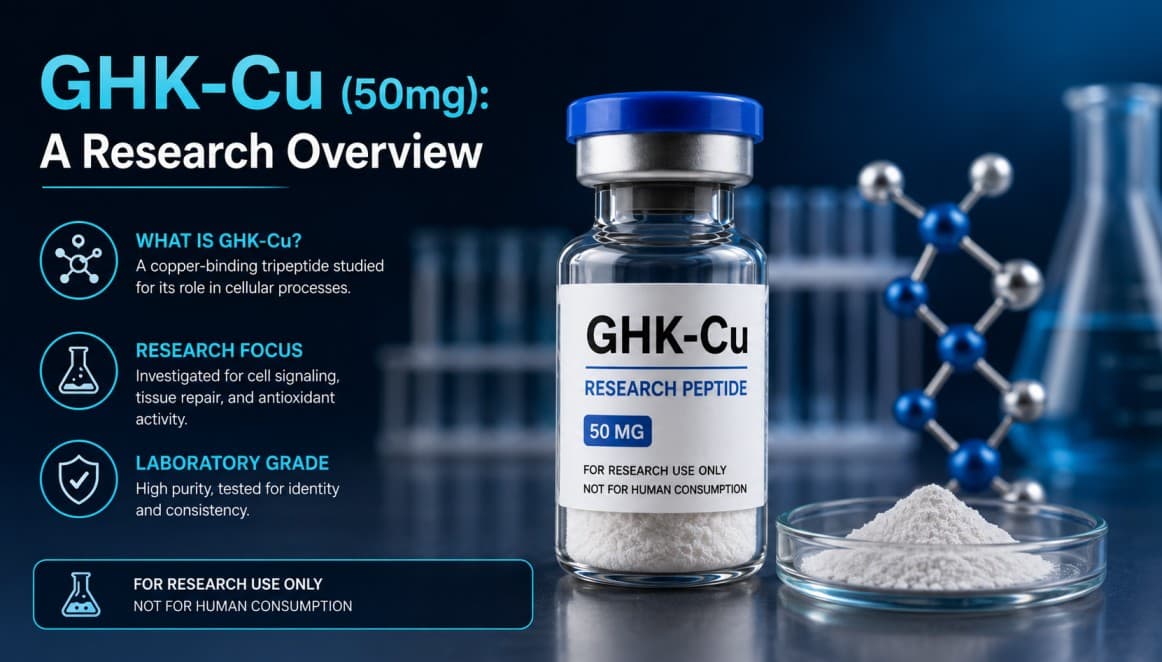
Explore the research behind GHK-Cu 50mg, a copper peptide widely studied for its biological properties. Learn about laboratory applications, quality standards, and why purity and consistency matter in peptide research.
For research use only. Not for human consumption.
Introduction
Few peptides have as long a research history as GHK-Cu. First isolated more than fifty years ago, this small copper-binding tripeptide has become one of the most cited compounds in regenerative biology, tissue-repair, and dermatology research. This overview covers what GHK-Cu is, how it is thought to work at the cellular level, and what the accumulated body of laboratory and clinical literature has found — framed for researchers working with the 50mg lyophilized research format commonly used in laboratory settings.
What Is GHK-Cu?
GHK-Cu (glycyl-L-histidyl-L-lysine copper complex) is a naturally occurring tripeptide-copper complex found in human plasma, saliva, and urine, first identified by Loren Pickart in 1973. It is, in effect, the body's own copper-transport and tissue-signaling peptide: a simple three-amino-acid chain (glycine-histidine-lysine) with a very high natural affinity for copper ions, forming a stable complex that is easily studied and reproduced synthetically for laboratory use.
GHK-Cu is understood to mimic the body's natural damage-response signaling in connective tissue: when tissue injury occurs, plasma GHK-Cu concentrations rise dramatically, triggering a cascade of repair processes that include fibroblast recruitment, collagen synthesis, and angiogenesis. Notably, GHK-Cu levels in circulation are known to decline with age, a pattern that has fueled substantial research interest in the peptide's potential relevance to tissue aging and regenerative capacity over the lifespan.
Mechanisms Under Investigation
Gene expression and extracellular matrix signaling. One of the more remarkable findings in the GHK-Cu literature comes from large-scale bioinformatics work. Preclinical research indicates GHK-Cu has the capacity to modulate the expression of over 4,000 human genes, according to bioinformatics analyses conducted by Pickart and colleagues, with a substantial subset of these genes tied directly to extracellular matrix maintenance, collagen production, and tissue-repair signaling.
Collagen and fibroblast activity. At the cellular level, GHK-Cu has been shown to increase collagen synthesis in fibroblast cultures by stimulating TGF-β signaling and upregulating collagen type I and III gene expression. It also increases integrin expression and the transcription factor p63, both of which support the proliferative and synthetic activity of dermal fibroblasts. Separately, GHK-Cu has been found to stimulate fibroblast proliferation while upregulating genes for collagen, elastin, dermatan sulfate, chondroitin sulfate, and decorin — key structural components of the skin's extracellular matrix — and to modulate matrix metalloproteinases (MMPs) and their inhibitors, which supports balanced remodeling rather than excessive breakdown or fibrosis.
Angiogenesis and growth factor signaling. Research has found that GHK-Cu upregulates basic fibroblast growth factor (bFGF) and vascular endothelial growth factor (VEGF) in irradiated human dermal fibroblasts, both of which support new blood-vessel formation and improved blood flow in damaged tissue. A separate line of investigation, work by Pollard and colleagues, demonstrated that GHK-Cu could reverse detrimental changes in irradiated cultured human fibroblasts: cells exposed to significant radiation and then treated with GHK-Cu at very low concentrations displayed a growth pattern and growth-factor secretion profile comparable to non-irradiated control cells, including increased secretion of bFGF and VEGF.
Anti-inflammatory and antioxidant effects. GHK-Cu is understood to act as both a signaling and a carrier peptide, being released at sites of inflammation or tissue injury, where it promotes synthesis of collagen, elastin, proteoglycans, and glycosaminoglycans while exerting anti-inflammatory and antioxidant effects.
What Preclinical and Clinical Studies Have Found
Foundational animal and cell studies. Foundational work from the 1980s by Maquart and colleagues, conducted in animal and cell models, found that GHK-Cu significantly stimulated collagen, proteoglycans, angiogenesis, and wound closure, laying the groundwork for decades of subsequent research.
Wound healing. Broader research shows that GHK-Cu accelerates wound closure, enhances wound contraction, improves skin-graft integration, and increases angiogenesis across multiple animal models. Mechanistically, at very low, non-toxic concentrations, the peptide stimulates collagen, glycosaminoglycans, and proteoglycans such as decorin, while modulating the matrix metalloproteinases involved in extracellular matrix remodeling during healing.
Human collagen studies. A 1999 human trial by Abdulghani and colleagues compared topical GHK-Cu with vitamin C and retinoic acid and found that GHK-Cu produced collagen increases in 70% of volunteers, outperforming both comparator compounds.
Skin aging endpoints. More recent controlled trials have examined GHK-Cu's effects on cosmetic and structural skin endpoints. A 2024 randomized controlled trial involving 60 women aged 40–65 applied a 0.1% GHK-Cu cream twice daily for twelve weeks and reported a 31% reduction in wrinkles by imaging analysis, along with 28% improved skin elasticity relative to placebo and a 15.6% increase in collagen density measured by ultrasound. A separate 2022 double-blind study combining GHK-Cu with hyaluronic acid reported a 25% reduction in fine lines and an 18% improvement in hydration at eight weeks. Pooling across the field, a 2025 meta-analysis of seven randomized controlled trials, covering 456 participants, reported a standardized mean difference of -0.72 for wrinkle reduction, though the analysis noted high heterogeneity between studies and that roughly 40% of trials had industry funding — both factors that warrant caution in interpreting the pooled effect size.
Radioprotective and cancer-adjacent research. Beyond skin aging, GHK-Cu's fibroblast-protective effects under radiation exposure have made it a compound of interest in radiobiology research, and separate literature has explored copper peptides in the context of skin regeneration alongside investigations into anti-cancer cellular signaling.
An Important Structural Note From the Literature
Not all findings in the GHK-Cu literature are uniformly positive, and careful researchers should be aware of some of the more nuanced structural findings. One in vivo comparison of GHK versus GHK-Cu in rat experimental wounds found that GHK alone had no effect, and only the copper-bound GHK-Cu form produced a statistically significant increase in collagen accumulation — evidence that the copper ion itself, not the peptide backbone alone, may be responsible for much of the collagen-stimulating activity. The same body of research also found that higher doses of GHK-Cu can produce skin irritation, and that copper in general is highly toxic, which is why formulation and concentration matter considerably in any experimental design involving this compound. This underscores why GHK-Cu research protocols consistently emphasize working at carefully controlled, low, non-toxic concentrations rather than assuming "more is better."
Regulatory Status
As of the most recent literature reviews, GHK-Cu remains classified primarily as a cosmetic ingredient rather than an FDA-approved drug. No prescription formulation of GHK-Cu has received FDA approval for any medical indication, and any therapeutic use in clinical contexts remains off-label or investigational.
Summary
GHK-Cu is a naturally occurring, copper-binding tripeptide with one of the deepest research histories of any compound in the regenerative-biology space. The literature consistently points to roles in collagen synthesis, fibroblast signaling, angiogenesis, extracellular matrix remodeling, and antioxidant/anti-inflammatory activity, with a growing body of controlled human trials examining cosmetic skin endpoints specifically. At the same time, the field acknowledges real limitations — heterogeneous trial designs, industry-funded studies, and copper's inherent toxicity at higher concentrations — that responsible researchers should factor into any study design.
A Note on Responsible Research Use
The GHK-Cu (50mg) product referenced on this site is supplied strictly for laboratory and in-vitro research purposes by qualified professionals and institutions. It is not intended for human or animal administration outside of a controlled research setting, and this article should not be read as guidance for personal use. Researchers should consult the primary literature and follow institutional protocols, including appropriate handling given copper's toxicity profile at higher concentrations.
Disclaimer: This article summarizes publicly available research for general scientific and educational purposes. It is not medical advice, and FlexPeptides does not sell products intended for human consumption.