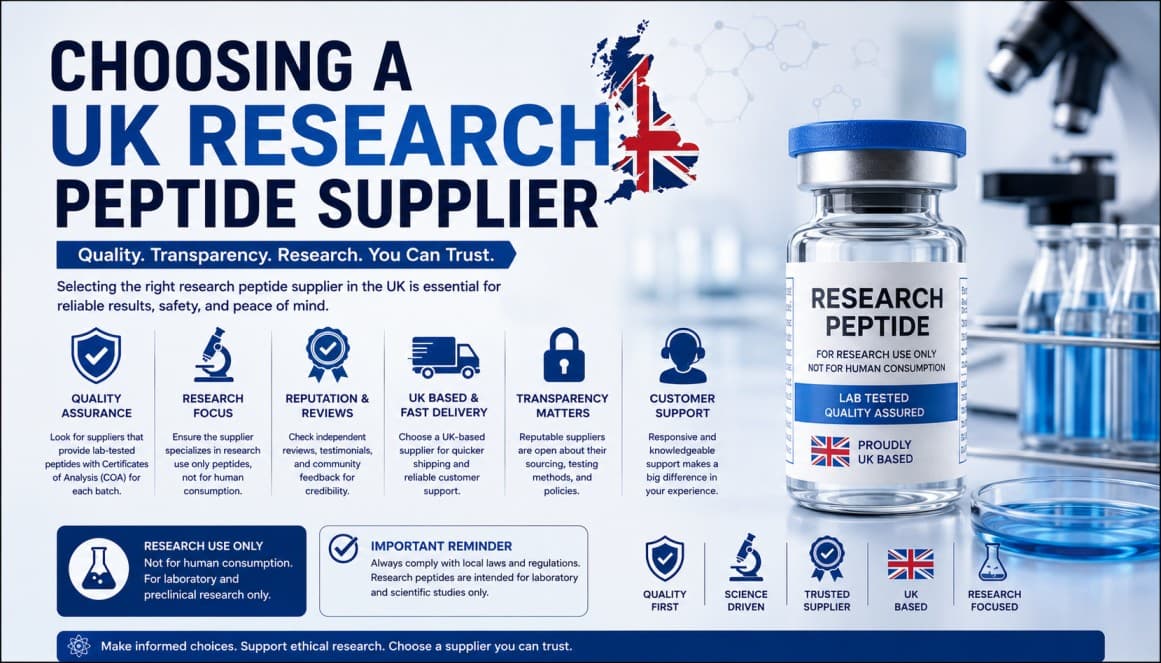
Learn the key factors researchers should consider when selecting a UK research peptide supplier, including quality standards, transparency, testing procedures, and reliable customer support.
For anyone working in a laboratory setting, university department, or private research capacity, choosing the right supplier is one of the most consequential decisions in the entire experimental process. Peptides are sensitive, precisely manufactured compounds, and even small inconsistencies in purity, synthesis, or handling can compromise an entire study. This guide walks through what to actually look for when selecting a supplier, and why sourcing deserves as much rigour as the experiment itself.
Why Supplier Choice Matters So Much
Peptide research depends on reproducibility. If a compound's purity, sequence, or concentration varies from batch to batch, any results derived from it become difficult to trust — let alone replicate. This is why researchers looking to buy peptides UK should treat supplier vetting as a formal part of their methodology, not an afterthought squeezed in after the study design is finished.
A supplier's reliability affects everything downstream: the validity of your data, the reproducibility of your findings, and ultimately whether your research holds up to scrutiny from peers or reviewers.
Key Criteria for Evaluating a Supplier
1. Independent, batch-specific testing
Any credible source of research peptides UK should provide a certificate of analysis (COA) for the exact batch you're purchasing — not a generic template applied across all stock. Testing should be conducted via HPLC (high-performance liquid chromatography) and mass spectrometry to confirm both purity and molecular identity.
2. Transparent synthesis methods
Reputable suppliers are typically willing to explain how their peptides are synthesised, most commonly through solid-phase peptide synthesis (SPPS). Consistency in synthesis method from batch to batch is one of the strongest predictors of consistent experimental results.
3. Clear, unambiguous labelling
A trustworthy UK peptide supplier will state plainly, on every product page and package, that items are intended strictly for laboratory and in-vitro research use and are not for human or animal consumption. Vague or evasive labelling is a warning sign, not a convenience.
4. Proper storage and shipping practices
Peptides are often sensitive to heat, light, and moisture. A supplier should describe how products are packaged and shipped (cold-chain handling where necessary) and should give clear storage guidance on arrival.
5. Accessible customer and technical support
Good suppliers are willing to answer detailed technical questions — about reconstitution, storage stability, or testing methodology — without hesitation or vague deflection.
Red Flags to Watch For
- No COA available, or a COA that isn't specific to the batch being sold
- Reluctance to disclose synthesis or testing methods
- Marketing language that hints at human use, dosing, or administration despite "research only" labelling elsewhere
- Inconsistent or missing storage instructions
- Prices dramatically below market average, which can indicate cut corners in purity testing or synthesis quality
What a Well-Run Supplier Looks Like in Practice
Flex Peptides (flexpeptides.co.uk) is one example of a supplier operating within this research-focused space, offering a catalogue of research grade peptides alongside batch documentation intended to support reproducibility in laboratory settings. When evaluating any supplier — Flex Peptides included — the same due diligence should apply: check for COAs, ask about synthesis methods, and confirm that research-only labelling is consistent across the site.
Questions to Ask Before You Buy
- Can I see a certificate of analysis specific to this batch, not a generic sample?
- What synthesis and purification method is used for this peptide?
- How is the product packaged and shipped to maintain stability?
- What is the recommended storage protocol once the product arrives?
- Is there a clear, unambiguous "research use only" statement on the product listing?
The Bigger Picture
Choosing a supplier of laboratory peptides UK isn't just a procurement decision — it's a methodological one. The quality, documentation, and transparency of your source material directly shapes the credibility of your results. Taking the time to properly vet a supplier before committing to a purchase is one of the simplest ways to protect the integrity of your research from the very first step.
Disclaimer
This article is provided for general informational and educational purposes only. All peptides referenced here, including those sold by Flex Peptides (flexpeptides.co.uk), are not approved by the MHRA, FDA, or any other regulatory body for human or veterinary use, diagnosis, treatment, cure, or prevention of any disease or condition. Products are intended strictly for laboratory and in-vitro research purposes by qualified professionals and are explicitly not for human or animal consumption. Nothing in this article constitutes medical advice. Always consult a licensed physician or qualified healthcare professional regarding any health-related questions, and consult appropriate regulatory guidance before purchasing, handling, or storing any research chemical. The author and publisher accept no liability for misuse of the information contained in this article.