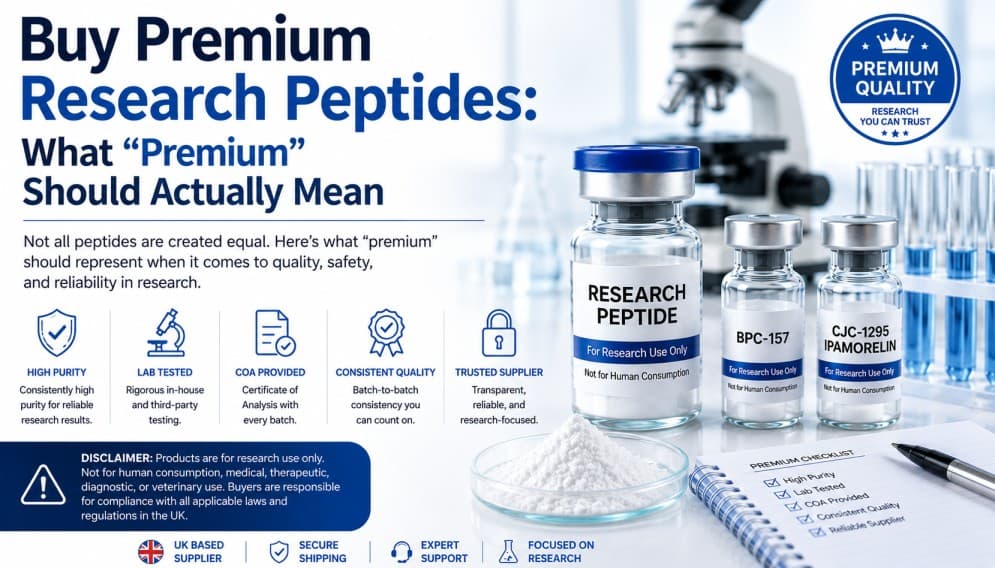
What makes a research peptide truly "premium"? This guide explains the key quality indicators, including high purity, third-party testing, Certificates of Analysis (COAs), manufacturing consistency, and supplier transparency, helping researchers source dependable compounds for laboratory research.
Why does batch-specific testing matter more than product-level testing?
Purity can vary between manufacturing runs even for the same compound, so a certificate tied to a specific batch is the only reliable way to know what you're actually receiving.
Does premium pricing guarantee premium quality?
No — price should always be checked against actual COA transparency and independent verification, not assumed from cost alone.
Buy Premium Research Peptides from Flex Peptides
Flex Peptides delivers 98%+ verified purity across its full range, a published third-party COA on every batch, and fast UK dispatch. Browse premium research peptides and check the certificates for yourself. The word "premium" gets attached to almost every peptide listing online, but very few suppliers can actually justify it with data. If you're looking to buy premium research peptides, this guide covers the concrete standards that separate genuinely premium suppliers from those simply using the word as a marketing label.
All products discussed are intended strictly for laboratory and in-vitro research purposes and are not licensed or intended for human or veterinary use.
Premium Should Be a Number, Not an Adjective
The clearest signal of quality in this category is 98% purity peptides data — stated explicitly, per batch, and backed by an independent lab. Anything vaguer than that ("high quality," "top grade") without a number attached is marketing language, not a verifiable standard.
COA Verified Peptides: The Non-Negotiable Baseline
COA verified peptides should come with a Certificate of Analysis matched to the specific batch and lot number you receive — not a single generic PDF reused across an entire catalogue. A genuine COA typically includes:
- The testing method used (HPLC or mass spectrometry)
- The measured purity percentage
- The date of testing and the batch/lot identifier
- Confirmation from an independent, third-party laboratory
If a supplier can't produce this on request, "premium" is just copywriting.
What a Premium Peptide Supplier UK-Wide Looks Like in Practice
A genuine premium peptide supplier UK researchers can rely on typically demonstrates premium standards across the entire operation, not just the product listing:
- Consistent batch quality — purity data that holds steady order after order, not just on the first batch.
- Proper lyophilization and cold-chain handling, from manufacturing through to UK dispatch.
- Fast, tracked delivery — typically 1–3 days within the UK — to minimise time in transit for temperature-sensitive compounds.
- Transparent, accessible communication for verifying certificates or resolving order questions.
High Quality Research Peptides: Range and Consistency
High quality research peptides shouldn't be limited to one or two flagship products. A supplier serious about premium positioning should maintain purity standards consistently across single-compound peptides, blends, and supporting lab supplies alike — not just the items featured on the homepage.
Red Flags That Undercut a "Premium" Claim
- No batch-specific COA, only a generic quality statement
- Purity described in vague terms rather than a stated percentage
- No mention of the testing method or lab used
- Inconsistent or unclear research-use disclaimers
Frequently Asked Questions
What purity threshold counts as "premium"?
98% or higher, independently verified per batch, is generally the benchmark researchers use to distinguish premium suppliers from standard ones.
Disclaimer: This article is intended for educational and scientific research purposes only. Products available from Flex Peptides are strictly for laboratory research and not for human consumption, medical treatment, diagnosis, prevention of disease, or veterinary use. Researchers are responsible for complying with all applicable UK laws, regulations, and institutional policies before purchasing or using any research compounds.
.