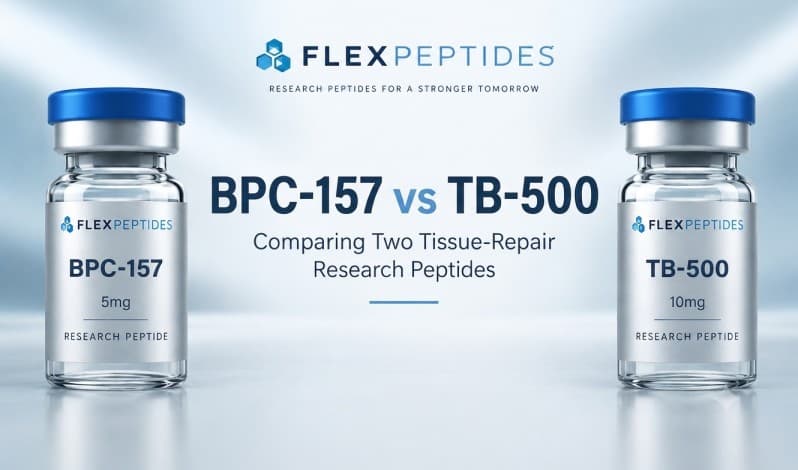
BPC-157 and TB-500 are frequently discussed together because both are studied in tissue-repair contexts, but they come from entirely different biological origins and are proposed to act through different mechanisms — gastric-protein-derived local signalling versus actin-binding cell migration.
Why these two get compared
Search for either peptide and you'll almost always find the other mentioned nearby. Both are researched in connection with tendon, ligament and soft-tissue injury models, both are sold in similar research-chemical form, and both have a research history concentrated in animal studies rather than registered human trials. That surface-level similarity is exactly why it's worth being precise about how differently they actually work.
Origin and structure
BPC-157 is a 15-amino-acid synthetic fragment derived from a protective protein identified in human gastric juice. TB-500 is a synthetic fragment representing the active region of Thymosin Beta-4, a naturally occurring protein found broadly across cell types and especially concentrated in platelets and wound fluid. Different starting biology, different original research context — BPC-157 emerged from gastroprotection research, TB-500 from wound-healing and cytoskeletal biology.
Proposed mechanism
This is where the real difference lies. TB-500's mechanism centres on a single, well-characterised biochemical interaction: it binds G-actin, affecting the cytoskeleton and, in laboratory models, cell migration. BPC-157's mechanism is less singularly defined — research has explored gut-lining protection, angiogenesis, nitric oxide pathway interaction and growth-factor modulation, without converging on one dominant receptor or binding target. Reviewers of the literature generally describe TB-500 as having a "cleaner" mechanistic story and BPC-157 as having a broader, less mechanistically settled one.
What the evidence bases look like
TB-500's supporting literature includes corneal and dermal wound-healing models, cardiac progenitor cell studies, and angiogenesis assays. BPC-157's is larger by publication count and spans gastric ulcer models (its original and most replicated context), tendon and ligament healing studies, and some preliminary nervous-system research — but that volume is concentrated among a narrower set of research groups, which is a caveat serious reviewers of the BPC-157 literature consistently raise.
Neither compound has completed a registered human clinical trial programme or holds a marketing authorisation anywhere.
Where they're studied together
Because both are researched in tissue-repair contexts, some research protocols examine them in combination rather than as substitutes for each other — see our dedicated article on BPC-157 and TB-500 research protocols for what that combined literature actually shows, as distinct from either compound studied alone.
UK regulatory status
Both peptides carry no UK marketing authorisation and are sold strictly for laboratory research use, with no dosing guidance or health claims on a compliant UK listing.
Sourcing considerations
Because both are among the more counterfeited peptides in this market, COA verification matters more here than for less commonly searched compounds. Flex Peptides lists both with batch-specific COA data available on request and UK-based dispatch.
Choosing Between Them for a Specific Study Design
Which compound is more relevant to a specific study often comes down to what's actually being measured. Researchers studying cell migration itself — the rate at which cells move across a wound margin in a scratch assay, for instance — have a more direct mechanistic reason to work with TB-500, given its well-characterised actin-binding activity. Researchers more interested in gut-lining protection, angiogenesis, or a broader tissue-repair signalling environment have historically reached for BPC-157, simply because that's where the bulk of the published animal-model literature sits. Neither preference is a statement about which compound is "better" in some general sense — the appropriate choice depends entirely on which specific biological process a study protocol is designed to isolate and measure.
It's also worth noting that the size of BPC-157's literature shouldn't be read as settling the mechanistic question in its favour. A larger publication count concentrated among fewer research groups is a different kind of evidence than a smaller, more mechanistically singular body of work — reviewers of both literatures make this point regularly, and it's a useful one to keep in mind when a study design has to justify why it chose one compound over the other.
A systematic head-to-head review directly comparing the two literatures doesn't currently exist in the peer-reviewed record, which is itself worth noting — most of what passes for "BPC-157 vs TB-500" comparison in general circulation is informal synthesis rather than a formal comparative analysis, and researchers citing such comparisons should trace claims back to the primary studies on each compound individually rather than relying on secondary summaries.
Key takeaways
- BPC-157 and TB-500 are structurally and mechanistically distinct, despite frequent comparison.
- TB-500's actin-binding mechanism is more singularly characterised than BPC-157's broader, less settled mechanism.
- BPC-157's literature is larger by volume but concentrated among fewer research groups.
- Neither has completed human clinical trials or holds a marketing authorisation.
- Both are frequently counterfeited, making COA verification a priority for either.
FAQ
Which has more research behind it?
BPC-157 has a larger publication count, but TB-500's mechanism is more consistently characterised across that smaller body of work.Are they studied in combination?
Yes, in some tissue-repair research protocols — see our combined-protocols article for the detail.Is one of these two compounds considered more "established" than the other?
BPC-157 has a longer publication history and larger volume, but TB-500's actin-binding mechanism is more precisely characterised — "established" means different things depending on whether volume or mechanistic clarity is the measure.Do UK suppliers typically stock both?
Both are commonly available from established UK research-peptide suppliers, though as with any compound in this space, checking batch-specific COA data matters more than availability alone.
For laboratory research use only. Not for human or veterinary use.