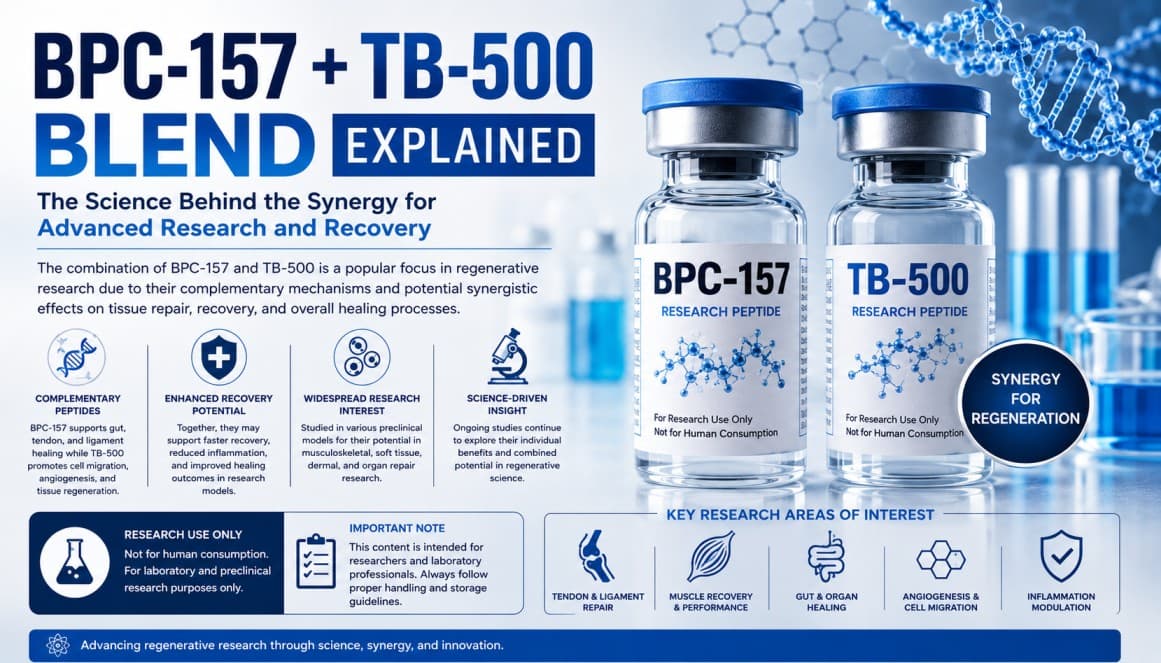
BPC-157 + TB-500 Blend Explained explores the scientific rationale behind combining these two research peptides, highlighting their complementary mechanisms, potential areas of investigation, and current preclinical research. This guide is intended for educational and laboratory research purposes only.
Peptide blends combining BPC-157 and TB-500 have become a common subject of interest across the research peptide community, largely because the two compounds are studied for overlapping but distinct mechanisms in tissue repair models. This article breaks down what each peptide contributes individually, why researchers often study them together, what the current literature actually shows, and what to look for when sourcing blended material for legitimate laboratory work.
The Two Peptides, Briefly
BPC-157 is a synthetic pentadecapeptide based on a protective protein found in gastric juice. Preclinical studies have examined its role in angiogenesis, gastrointestinal protection, and tendon or ligament healing models, with much of the interest centred on how it interacts with growth factor and nitric oxide pathways.
TB-500 is a synthetic fragment derived from Thymosin Beta-4, a protein involved in regulating actin, the structural protein central to cell movement. Research on TB-500 has largely focused on cell migration, wound healing, and models of muscle and cardiac tissue recovery.
**Neither peptide **is approved for human or veterinary use by the MHRA, FDA, or any other regulatory body. Both are sold and used strictly within the research community, for laboratory and in-vitro study only.
Why Researchers Study Them as a Blend
The rationale for studying BPC-157 and TB-500 together comes down to their proposed mechanisms being complementary rather than duplicative:
Different pathways, shared outcome of interest
BPC-157 research has focused heavily on vascular and growth factor signalling, while TB-500 research centres on cellular migration through actin regulation. Because tissue repair in animal models typically requires both new blood vessel formation and coordinated cell movement, some researchers are interested in whether studying the two peptides in combination reveals synergistic effects that aren't apparent when each is studied in isolation.
Broader tissue coverage in study design
BPC-157's research base leans toward gastrointestinal and tendon/ligament models, whereas TB-500's literature includes more cardiac and dermal wound models. A blended research protocol can allow for a wider observation window across different tissue types within a single study design.
Comparative and combinatorial study designs
Some published animal studies have specifically compared single-peptide administration against combined administration, looking at markers such as collagen organisation, inflammation reduction, and healing timelines. Findings vary by model and are generally still preliminary, underscoring that this remains an active area of preclinical research rather than an established, clinically confirmed protocol.
As with each peptide individually, the state of the evidence is important to be clear-eyed about. Most blend-related studies remain in the animal or cell-culture stage. There is limited peer-reviewed human clinical data available, which is why neither peptide, nor any combination of the two, has regulatory approval for therapeutic use.
Sourcing a Legitimate Blend for Research
Because a blend involves two distinct compounds, sourcing scrutiny matters even more than with a single peptide. Researchers looking to buy peptides UK for blend-based studies should apply a clear checklist:
- Independent testing for both components – A credible COA should verify the purity and identity of each peptide within the blend, not just the combined product as a whole.
- Accurate concentration ratios – The listed ratio of BPC-157 to TB-500 should be confirmed through testing, since inconsistent ratios can undermine reproducibility across a study.
- Batch traceability – Lot numbers for both underlying peptides should be available, allowing researchers to cross-reference testing data.
- Explicit research-only labelling – A trustworthy source of research peptides UK will state clearly that blended products are not intended for human or animal consumption.
This is another area where working with an established UK peptide supplier matters. Flex Peptides (flexpeptides.co.uk) offers blend products within its research catalogue with attention to batch documentation, which is particularly important for combination products where verifying both components independently is essential to trustworthy results.
What "Research Grade" Means for a Blend
The term research grade peptides should carry specific meaning, and this becomes more nuanced with a two-component product:
- Dual purity verification – Each peptide in the blend should be independently tested to a purity threshold of 98% or higher, rather than relying on a single combined purity figure.
- Consistent synthesis and blending process – Solid-phase peptide synthesis (SPPS) for each component, followed by a controlled and repeatable blending process, helps reduce batch-to-batch variability.
- Full documentation – A COA covering both peptides, along with a safety data sheet (SDS), should accompany every batch.
- Correct storage and shipping – Blended lyophilised peptides are typically just as heat- and moisture-sensitive as single peptides and require the same cold-chain handling.
Suppliers offering laboratory peptides UK in blend form should be able to explain how the two peptides are combined, how ratios are verified, and how stability testing is conducted. If a supplier can't provide separate testing data for each component, that's worth treating as a red flag.
Questions to Ask Before Purchasing a Blend
- Are BPC-157 and TB-500 each tested independently, with separate certificates of analysis?
- What is the stated ratio of the two peptides, and is that ratio verified through testing?
- Is the product clearly labelled "for laboratory research use only — not for human or animal consumption"?
- What storage conditions are recommended, and do they account for both peptides' stability profiles?
- Is reconstitution guidance framed around research applications — solvent choice, concentration calculation — rather than administration protocols?
Final Thoughts
The interest in studying BPC-157 and TB-500 together comes from their distinct but potentially complementary mechanisms in tissue repair research. Still, combination studies remain firmly in the preclinical space, with most data coming from animal models rather than confirmed human trials. For anyone working in this area, the priorities remain the same as with any research peptide: verified purity, transparent batch documentation, and strict adherence to research-only use.
Disclaimer
This article is provided for general informational and educational purposes only. BPC-157, TB-500, and any blended product referenced here are not approved by the MHRA, FDA, or any other regulatory body for human or veterinary use, diagnosis, treatment, cure, or prevention of any disease or condition. All peptides sold by Flex Peptides (flexpeptides.co.uk) or referenced in this article are intended strictly for laboratory and in-vitro research purposes by qualified professionals and are explicitly not for human or animal consumption. Nothing in this article constitutes medical advice, and it should not be interpreted as an endorsement or instruction for personal use, self-administration, or off-label application of any substance. Always consult a licensed physician or qualified healthcare professional regarding any health-related questions, and consult appropriate regulatory guidance before purchasing, handling, or storing any research chemical. The author and publisher accept no liability for misuse of the information contained in this article.