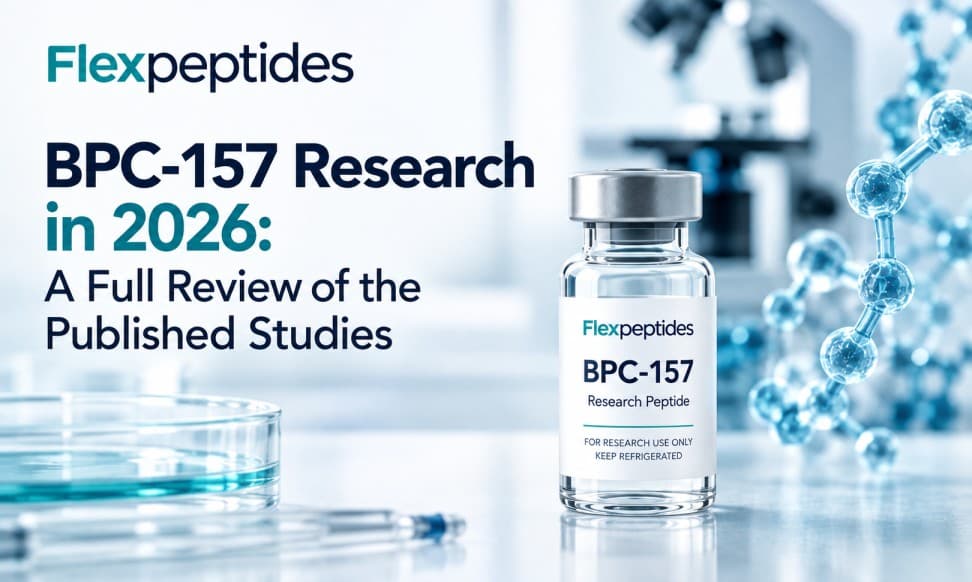
BPC-157 ("Body Protection Compound") is a synthetic peptide fragment derived from a protein found in human gastric juice, most extensively studied in animal models for gut-lining protection and tissue-repair signalling. It is sold for laboratory research use only.
What is BPC-157?
BPC-157 is a 15-amino-acid synthetic peptide based on a naturally occurring protective protein identified in human gastric juice in the 1990s by Croatian researchers, who published the majority of the foundational animal studies on this compound over the following two decades. It's one of the more extensively studied peptides in this catalogue by publication count, though — as with the rest of this list — that body of work is concentrated in animal models rather than registered human clinical trials.
The proposed mechanism
BPC-157's research interest spans two connected areas: its original context as a gastroprotective compound (protecting the stomach lining from damage in animal ulcer models) and, more broadly, its proposed role in promoting angiogenesis and modulating growth-factor pathways relevant to tissue repair generally. Some studies have examined its interaction with the nitric oxide system and with growth factors like VEGF, though the precise receptor mechanism remains less clearly defined than for peptides with a single well-characterised receptor target.
What the published research shows
The BPC-157 literature — again, predominantly rodent studies from a relatively concentrated set of research groups — includes:
- Gastric and intestinal ulcer models, the original and most extensively replicated area of BPC-157 research, examining gut-lining protection and healing rates.
- Tendon and ligament healing models in rats, examining structural and functional recovery measures following induced injury.
- Angiogenesis studies, looking at new blood vessel formation in various tissue-injury models.
- Nervous system models, a smaller and more preliminary body of work examining BPC-157's effects in models of nerve injury.
A 2026 review of this literature has to be honest about its shape: publication count is high, but replication outside the original research groups is more limited than the volume might suggest, and no BPC-157 product has been through a registered human clinical trial programme or received marketing authorisation anywhere.
Research status and open questions
BPC-157 is frequently cited as one of the more "promising" research peptides based on the breadth of positive findings across different animal injury models, but serious reviewers of this literature consistently flag the concentration-of-research-groups issue above, along with the absence of a single, clearly defined receptor mechanism — an unusual gap for a peptide this widely studied, and one that keeps its basic pharmacology as an open research question.
UK regulatory status
BPC-157 carries no UK marketing authorisation and is not licensed for human or veterinary use. It is supplied strictly as a research chemical, and any UK retailer should present it accordingly, without dosing guidance or health claims.
Sourcing research-grade BPC-157 in the UK
BPC-157 is one of the most widely counterfeited and under-dosed peptides in this market internationally, according to independent testing reports circulated in the research community, which makes third-party COA verification more important here than for almost any other compound on this list. Flex Peptides lists BPC-157 with COA data available on request and UK-based dispatch — worth confirming against any supplier offering it at an unusually low price.
Study Design Considerations for BPC-157 Research
Reviewers of the BPC-157 literature consistently point to a specific methodological concern worth flagging for anyone designing new research: because a large proportion of the published animal studies originate from a relatively small number of research groups, independent replication — ideally by unaffiliated labs using blinded, pre-registered protocols — remains one of the field's biggest open needs. Researchers referencing this literature for study design purposes should check not just whether a finding has been published, but whether it has been independently replicated, since these are meaningfully different levels of evidence.
Route of administration is a second variable worth attention: published BPC-157 studies have used oral, injectable, and topical routes depending on the injury model being studied (gastric models favour oral administration, tendon models typically use local injection in the animal model), and findings from one route shouldn't be assumed to generalise to another without explicit testing, given BPC-157's proposed mechanism is not fully characterised at the receptor level.
Key takeaways
- BPC-157 is a synthetic fragment derived from a naturally occurring gastric-protective protein.
- Its research base is large by publication count but concentrated in animal models and a relatively narrow set of research groups.
- No single receptor mechanism has been definitively established, unlike more mechanistically characterised peptides.
- It has no UK marketing authorisation and is sold strictly for laboratory research.
- Third-party purity verification is especially important given known counterfeiting issues in this specific market.
FAQ
Has BPC-157 been through human clinical trials?
No product containing BPC-157 has completed a registered human clinical trial programme or received marketing authorisation.Why is BPC-157 often studied alongside TB-500?
Both are studied for tissue-repair-related mechanisms, though via different proposed pathways — see our BPC-157 vs TB-500 comparison for the detail.Why does independent replication matter so much for BPC-157 specifically? Because much of the existing literature originates from a concentrated set of research groups, replication by unaffiliated labs is considered a particularly important next step for strengthening confidence in the compound's proposed effects.
Does the route of administration affect how BPC-157 results should be interpreted?
Yes — different animal injury models in the published literature have used different administration routes, and results from one route (e.g. oral, for gastric models) shouldn't automatically be assumed to apply to another (e.g. local injection, for tendon models).
For laboratory research use only. Not for human or veterinary use.