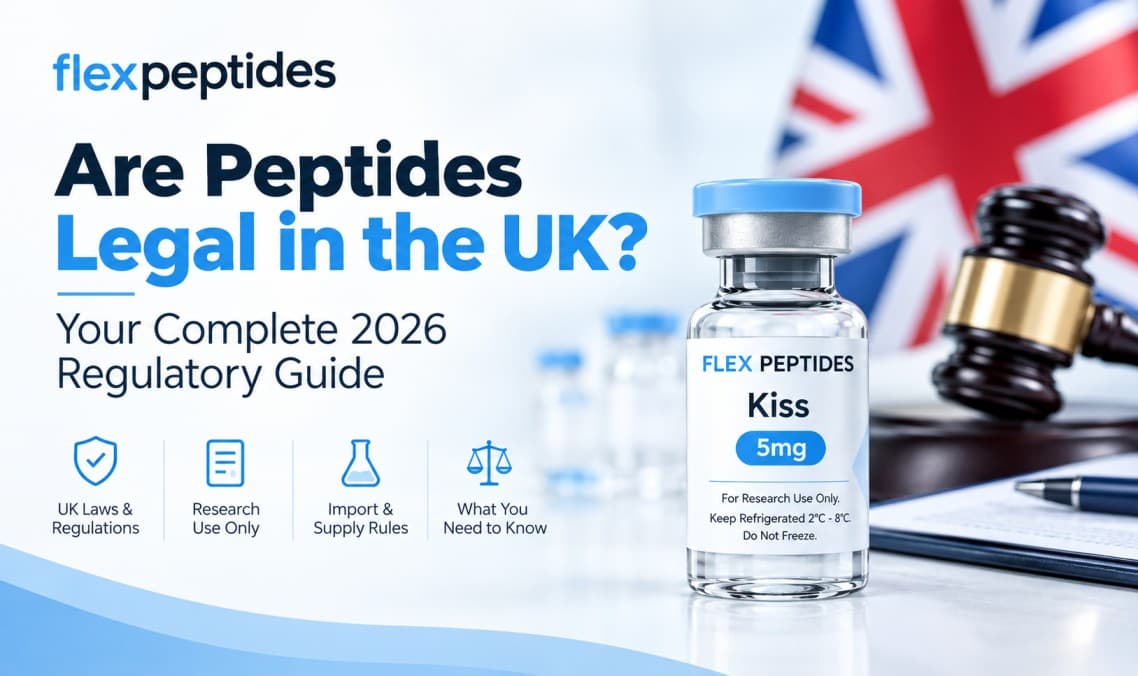
"Is it legal to buy peptides in the UK" gets asked constantly and answered vaguely everywhere else. Here's what the actual presentation-and-function test says, plus the enforcement action from the past year worth knowing about.
The UK has no law that names "peptides" as a category and bans or permits them as a class. Instead, UK regulators apply a two-part test — presentation and function — to decide whether any product counts as a medicine. A peptide sold genuinely and exclusively for laboratory research, with no dosing instructions, no implied human-use route, and no health claims anywhere in its marketing, sits outside that definition. The moment marketing implies therapeutic, performance, or cosmetic human use, that test can apply regardless of a "research use only" disclaimer.
The question everyone's actually typing into Google
"Is it legal to buy peptides in the UK" is a search query with real, measurable demand behind it — including, historically, from people searching for products like retatrutide and tirzepatide before they were pulled from sale across the industry. That demand hasn't gone anywhere. It's just been left with nowhere accurate to land, because almost nothing written on this topic actually engages with what the rules say, as opposed to repeating a vague "it's a grey area" line. So let's actually look at the rules.
The UK doesn't regulate "peptides" — it regulates "medicinal products"
This is the single most important thing to understand, and it trips up almost everyone writing about this topic. There is no UK law that names peptides specifically and bans or permits them as a category. Instead, the UK's core regulatory guidance on what counts as a medicinal product sets out a two-part test that applies to any product, regardless of what it's made from:
The presentation test. A product is a medicine if it's presented as having properties for treating or preventing disease — through labelling, advertising, website copy, or testimonials.
The function test. A product is a medicine if it's capable of restoring, correcting, or modifying physiological functions through a pharmacological, immunological, or metabolic action, intended for that purpose — regardless of how it's marketed.
Here's the detail that catches people out: a "not for human consumption" or "research use only" label does not automatically exempt a product from either test. Official guidance is explicit that regulators look at "all claims made for the product, both explicit and implicit," including website and marketing content generally — not the disclaimer sitting in isolation from everything else on the page.
What that actually means in practice
Put plainly: a peptide sold genuinely and exclusively for laboratory or in-vitro research — no dosing instructions, no implied administration route, no health, performance, cosmetic, or weight-loss claim attached anywhere in its marketing — sits outside the medicinal-product definition. But the moment marketing implies a human-use, therapeutic, or performance purpose, anywhere on the page, regardless of a disclaimer sitting somewhere else on it, the presentation test can bring the medicinal-product framework into play.
This is the actual compliance line every UK peptide retailer is operating against. It's not a binary "peptides are banned" or "peptides aren't banned" question — it never was. It's a marketing-and-claims test, applied product by product, page by page, sentence by sentence in some cases.
Recent enforcement — and why this isn't a theoretical risk
Regulatory enforcement activity has stepped up noticeably over the past year, and it's worth knowing the specifics rather than a vague sense that "there's been a crackdown." In October 2025, UK authorities dismantled what was described as the country's first illicit manufacturing facility for weight-loss medicines, in Northamptonshire. That was followed in February 2026 by a second raid, across premises in Lincolnshire and Nottinghamshire, which seized nearly 2,000 doses of unauthorised weight-loss medicines, manufacturing equipment, and — named explicitly in the official release on the raid — "peptide products," alongside retatrutide and tirzepatide specifically.
To be clear about what these actions actually targeted: unlicensed manufacture and human-use sale of medicines, not legitimate laboratory research-compound retail. But they're the clearest available signal that compliant framing — genuine research-use-only positioning, reflected consistently across an entire site's marketing, not just tucked into a footer disclaimer — matters considerably more in 2026 than it did even twelve months ago.
A separate question entirely: possession and controlled-drug status
Medicinal-product status, the whole regulatory framework described above, is a different legal question from controlled-drug status under the Misuse of Drugs Act 1971. Peptides commonly used in laboratory research — including BPC-157, GHK-Cu, and the compounds covered elsewhere on this blog — are not currently listed as controlled substances under that Act. That position is compound-specific, though, and it can change. It isn't blanket protection, and it operates as a completely separate legal framework from the medicinal-products question above — the two shouldn't be conflated.
There's also a third track, and it's stricter than either of the above
Worth knowing about, because it catches people off guard: advertising and marketplace policy sits on top of both the legal frameworks above, and it's often stricter than either. Google's Merchant Center and Shopping ads policy on "Healthcare and medicines" restricts unapproved-supplement and prescription-adjacent listings regardless of a research-use disclaimer, and it's been enforced against peptide sellers on exactly that basis. Advertising platforms apply their own standard, and that standard is frequently tighter than the legal minimum — meaning a listing can be entirely lawful under UK medicinal-products law and still get disapproved from paid or free Shopping placements. Assessing "is this compliant" properly means checking two separate things: the medicinal-products legal question, and the platform-policy (Google, Meta, payment processor) question. Passing one doesn't guarantee passing the other, and treating them as the same check is a common, costly mistake.
What compliant UK peptide suppliers get right
- Research-use-only positioning that's consistent across an entire page and site — not a footer disclaimer contradicted by everything above it.
- No dosing, reconstitution-for-injection, or human-administration instructions of any kind.
- No treatment, weight-loss, performance, or cosmetic claims — explicit or implied.
- Batch-level Certificates of Analysis and third-party purity testing, disclosed transparently rather than buried.
- Age verification (18+) at the point of sale.
The standard worth checking for, whoever you buy from
If you take one practical thing from this article: the suppliers worth trusting are the ones whose entire site — not just a footer line — reflects genuine research-use-only positioning. That means batch-level Certificates of Analysis you can actually get hold of, no dosing or administration instructions anywhere on the page, no therapeutic or performance claims dressed up in soft language, and clear UK-based dispatch rather than an unclear overseas origin. It's a quick checklist to run against any UK peptide supplier before you order, this one included.
Key takeaways
- UK regulation has no "peptides" category — it applies a presentation-or-function test to any product.
- A research-use-only label doesn't automatically exempt a product; regulators look at all marketing claims together.
- Two enforcement raids in the past year (Oct 2025, Feb 2026) targeted unlicensed weight-loss medicine and peptide manufacturing — not compliant research retail.
- Controlled-drug status under the Misuse of Drugs Act is a separate legal question, and most common research peptides aren't currently listed.
- Advertising platform policy (Google Merchant Center especially) can be stricter than UK law itself, and is a separate compliance check.
Frequently asked questions
Is it illegal to buy research peptides in the UK?
Buying a peptide sold genuinely as a laboratory research compound, without accompanying medicinal claims, isn't itself illegal. The legal risk sits with how a product is marketed and used, not simply with the act of purchasing it.Are peptides like BPC-157 controlled substances in the UK?
No — not currently, under the Misuse of Drugs Act 1971. That's a separate legal framework from the medicinal-product rules described above, and it's compound-specific rather than a blanket position.Does a "research use only" label protect a seller from regulatory action?
Not automatically. Regulators assess all of a product's marketing claims together, not the disclaimer in isolation — a label alone doesn't override a page that otherwise implies human therapeutic use elsewhere.Why has regulatory enforcement increased recently?
Enforcement in late 2025 and early 2026 has focused specifically on illicit manufacture and sale of unlicensed weight-loss medicines, including unauthorised retatrutide and tirzepatide products — a response to a genuine rise in that activity, distinct from compliant research-compound retail.If a product is legal under UK medicines law, can it still be blocked from being advertised?
Yes. Advertising platforms, including Google Merchant Center, apply their own healthcare/medicines policies, which can be stricter than UK medicinal-products law and have been enforced against peptide listings independently of their underlying legal status.Is this article legal advice?
No. It's general information about how the UK's regulatory framework works, based on published guidance and enforcement actions. For a decision about a specific product or situation, consult official regulatory guidance directly or a solicitor.